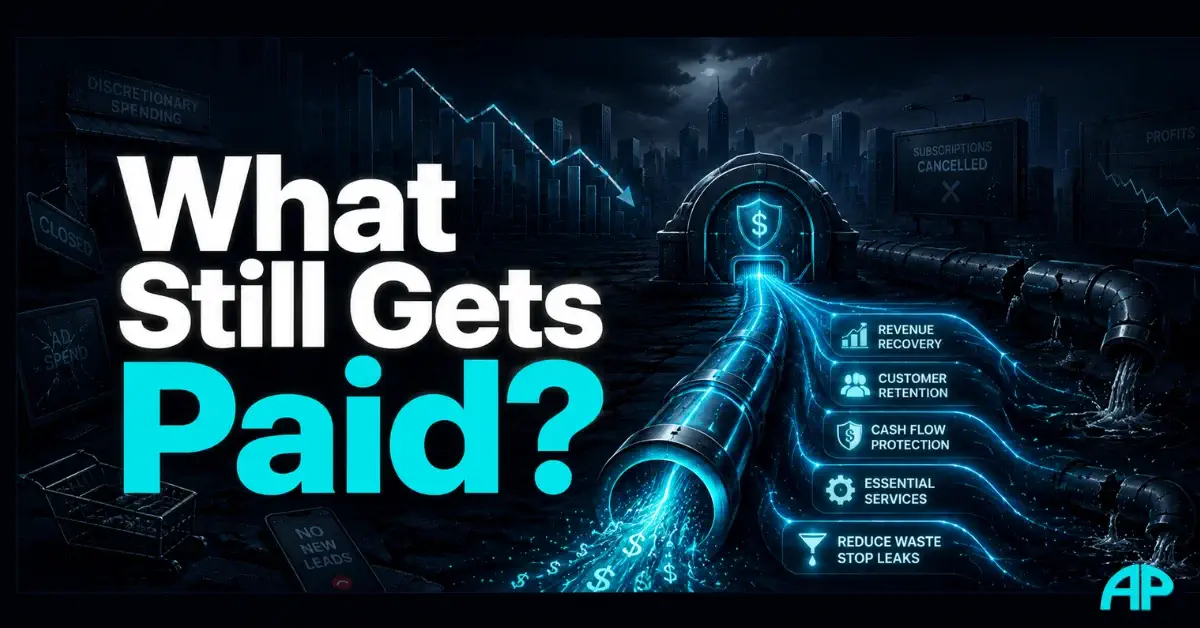
There is an uncomfortable truth about most recession-proof business ideas.
They only look safe while customers still feel safe.
When money becomes tight, behaviour changes quickly. People postpone purchases. They cancel subscriptions. They avoid unnecessary risks.
Businesses do exactly the same.
Yet most people preparing for an economic downturn still search for the next hot product, growing platform or clever side hustle.
However, that is usually the wrong place to start.
Instead, a stronger question is:
What will people continue paying for while they are cutting everything else?
The answer is surprisingly simple.
People and businesses will still pay to make money, save money, recover money or avoid losing money.
Therefore, that is where the real opportunity sits.
Table of Contents
- No Business Is Safe
- Stop Chasing More Leads
- The Revenue Recovery Model
- Why Clients Keep Paying
- Sell Outcomes, Not Tools
- Choose Better Clients
- Build a Simple Offer
- Why It Works Online
- Mistakes That Kill It
- Do Not Become an AI Agency
- The Real Opportunity
No Business Is Safe
Let’s be honest.
No business is completely recession-proof.
Essential businesses fail. Healthcare companies fail. Trades fail. Accountants fail. Even companies with strong demand can collapse because of debt, weak cash flow, poor management or rising costs.
However, some business models are much harder to kill than others.
Generally, the most resilient businesses share several important qualities:
- They solve an urgent problem
- They produce a measurable result
- They require little capital to operate
- They generate recurring revenue
- They serve customers who cannot ignore the problem
- They do not depend on one platform, product or country
As a result, many of the online business ideas promoted across social media immediately become less attractive.
A print-on-demand store is not recession-proof.
Likewise, a dropshipping store selling gadgets is not recession-proof.
A content website that relies entirely on search traffic is not recession-proof either.
Similarly, an online course teaching people how to become rich is not recession-proof.
Of course, these models can still work. For example, affiliate marketing for beginners can offer a relatively low-cost way to begin earning online.
Nevertheless, low-cost does not mean protected.
After all, many popular business models depend on discretionary spending, unstable traffic, paid advertising or customers who are already short of money.
The stronger model is often less glamorous.
However, it is also far more useful.
Stop Chasing More Leads

Most businesses believe they need more customers.
Often, they do not.
Instead, they need to stop wasting the customers and enquiries they already have.
Every day, businesses lose money through missed calls, slow replies, forgotten quotes, abandoned enquiry forms and poor follow-up.
For example, a potential customer calls, but nobody answers.
Meanwhile, someone else submits an enquiry and waits two days for a response.
Elsewhere, a quote gets sent, but nobody follows it up.
Similarly, a former customer may be due for another service, yet the business never contacts them.
None of this looks dramatic.
There is no flashing warning light. Likewise, there is no obvious moment when the owner sees thousands of dollars disappear.
Instead, the money leaks out slowly.
One missed enquiry here.
One forgotten quote there.
Then, one customer quietly goes somewhere else.
Over time, those small failures can cost a business far more than most owners realise.
Therefore, this problem creates the foundation for one of the strongest recession-resistant business models available today.
The Revenue Recovery Model
A revenue recovery business helps established companies make more money from the enquiries, customers and systems they already have.
Crucially, it does not begin by promising more traffic.
Instead, it begins by finding the money already leaking out of the business.
That may involve:
- Following up missed calls
- Reminding customers about quotes
- Reactivating previous customers
- Reducing appointment no-shows
- Requesting reviews automatically
- Following up overdue invoices
- Improving website conversion rates
- Creating email and SMS sequences
- Tracking leads properly
- Automating repetitive administration
- Protecting websites and customer data
In practice, the service sits somewhere between marketing, automation, customer retention, conversion optimisation and business consulting.
However, the client does not need to understand those labels.
Ultimately, the client only needs to understand one thing:
You are helping them recover money they are currently losing.
That is a much stronger proposition than saying:
“We build websites.”
“We manage social media.”
“We provide AI automation.”
After all, those services describe the tools.
Revenue recovery, on the other hand, describes the result.
A website becomes a tool.
Likewise, email marketing becomes a tool.
Automation becomes a tool.
AI becomes a tool.
The real product, therefore, is the financial outcome.
Why Clients Keep Paying
During strong economic periods, businesses often tolerate waste.
For instance, they spend money on branding exercises, experimental campaigns, new platforms and vague marketing strategies because cash is flowing.
During difficult times, however, that changes.
Suddenly, business owners start asking harder questions.
What are we getting back?
Can the result be measured?
Does this help us retain customers?
Can this reduce our costs?
Will it improve cash flow?
Consequently, services that cannot answer those questions become vulnerable.
Revenue recovery can answer them directly.
For example, if a system recovers ten missed enquiries each month, that can be measured.
Likewise, if a campaign brings back twenty inactive customers, that can be measured.
If an automation saves an employee ten hours each week, that can also be measured.
Furthermore, if better follow-up increases the number of accepted quotes, that can be measured as well.
The service does not become valuable because it sounds impressive.
Instead, it becomes valuable because removing it may cost the client more than keeping it.
That, ultimately, is the position every business should want to occupy.
Sell Outcomes, Not Tools
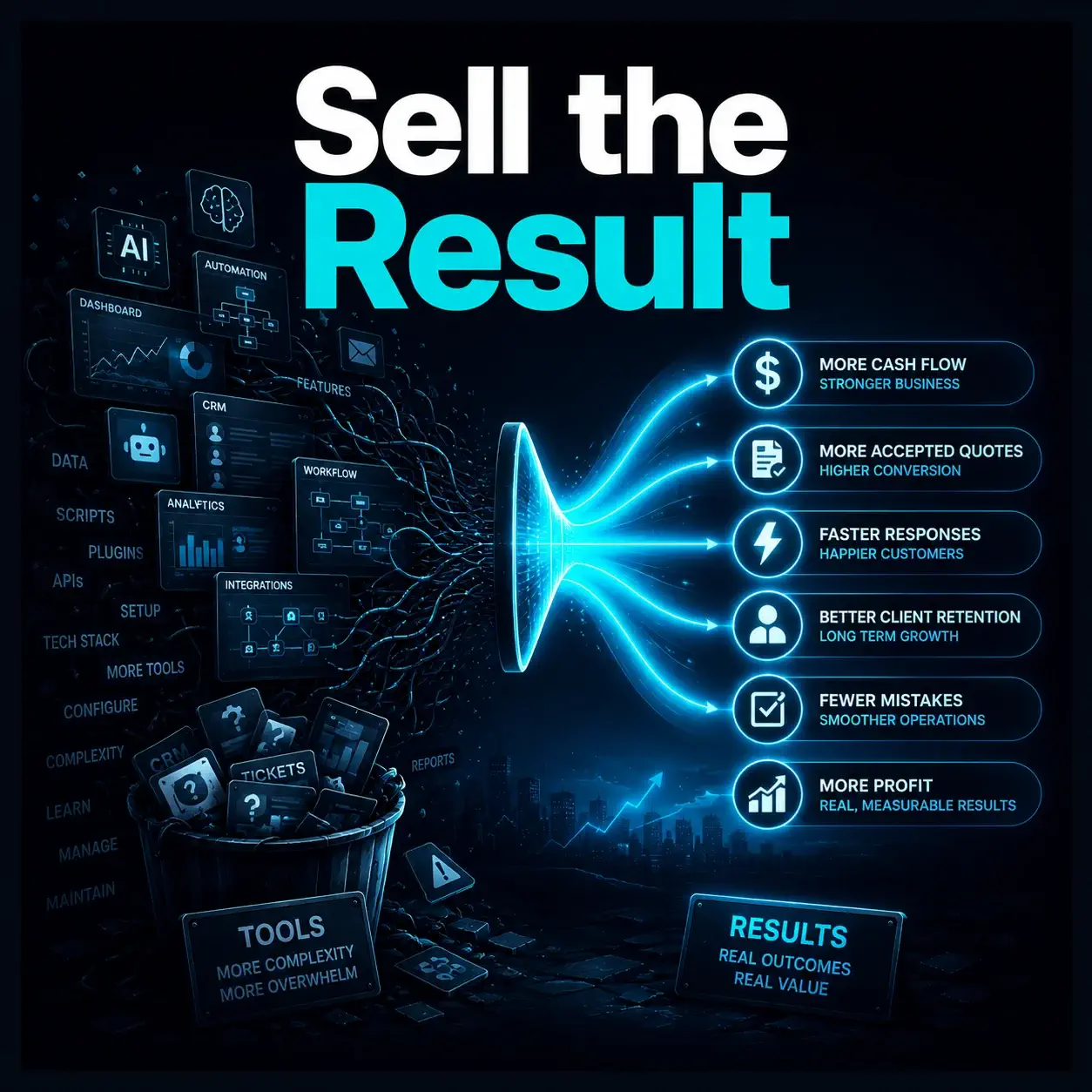
One of the biggest mistakes people make with AI and automation is trying to sell the technology itself.
In reality, most business owners do not want automation.
They want fewer mistakes.
They want faster responses.
They want less repetitive work.
They want more accepted quotes.
They want fewer missed appointments.
Most importantly, they want invoices paid sooner.
Therefore, do not sell an “AI-powered customer journey optimisation system.”
Instead, sell a system that responds to missed enquiries within two minutes.
Likewise, do not sell “intelligent workflow automation.”
Sell a process that saves the office manager ten hours every week.
Similarly, do not sell “advanced CRM implementation.”
Sell a simple way to make sure every viable lead receives a follow-up.
In other words, the technology should remain in the background.
The result should sit at the front.
Unfortunately, this is where many digital agencies get it wrong.
They sell websites, rankings, social posts and monthly reports.
Consequently, the client is left trying to work out what any of it means financially.
A stronger offer, however, connects every part of the service to revenue, savings or reduced risk.
Choose Better Clients
The strongest customers for this business model are usually established companies tied to practical, ongoing needs.
For example:
- Plumbers
- Electricians
- Air-conditioning companies
- Mechanical workshops
- Pest-control businesses
- Accountants
- Bookkeepers
- Allied-health providers
- Dental practices
- Aged-care services
- Security companies
- Fire and safety businesses
- Property-maintenance companies
- Compliance consultants
Of course, these businesses are not immune to recession.
However, their services are harder to postpone forever.
A blocked drain still needs fixing.
Likewise, a broken vehicle still needs repairing.
A tax obligation still needs handling.
Similarly, a safety inspection still needs completing.
Therefore, these businesses are often stronger prospects than luxury retailers, tourism operators, fashion brands or speculative start-ups.
Ideally, the client should already have staff, customers and a steady flow of enquiries.
That matters because you are not trying to create demand from nothing.
Instead, you are improving what already exists.
Build a Simple Offer
The business model does not need to become complicated.
In fact, the simpler the offer, the easier it becomes to understand and sell.
A strong structure has three stages.
1. The Revenue Leakage Audit
First, start with a paid audit.
Review how the business handles enquiries, missed calls, quotes, customer follow-up, website visitors and repetitive administration.
Then, show the owner where money is being lost.
A free audit often feels like a disguised sales pitch.
A paid audit, however, feels like professional advice.
More importantly, it allows you to diagnose the problem before recommending a costly solution.
2. The Implementation
Next, install the systems needed to fix the leaks.
This may include better enquiry forms, automated responses, follow-up sequences, customer reactivation campaigns, website improvements and clearer staff processes.
Although the tools may vary from one business to another, the objective should remain the same.
Recover revenue.
Improve efficiency.
Reduce waste.
Prevent unnecessary losses.
3. Ongoing Management
Finally, charge a monthly fee to monitor, maintain and improve the system.
For instance, that may include reporting, campaign management, conversion improvements, hosting, security, backups and ongoing automation.
As a result, you create recurring revenue while the client receives continued support.
At the same time, you move away from the exhausting cycle of constantly searching for another one-off project.
Why It Works Online
This is not only a recession-resistant business.
It is also a genuinely portable one.
For example, you do not need commercial premises.
You do not need inventory either.
Furthermore, you do not need to borrow heavily.
Instead, you can operate with a small remote team.
You can also serve clients in several countries.
Most importantly, you can standardise much of the delivery process.
Therefore, this model is particularly attractive for anyone trying to start an online business without taking on unnecessary financial risk.
It also reduces one of the biggest weaknesses found in many online business models.
You are not completely dependent on Google, Facebook, Amazon, YouTube or another platform continuing to send you traffic.
Instead, you own the client relationship.
That matters far more than most online entrepreneurs realise.
Of course, there is nothing wrong with exploring models such as ghost commerce, affiliate marketing or content publishing.
However, relying on one platform, traffic source or income stream creates vulnerability.
By contrast, a revenue recovery business becomes stronger when supported by your own website, email list, referrals, reputation and direct client relationships.
Mistakes That Kill It
Even so, this business model can still fail.
For example, it will fail if you promise results you cannot deliver.
Likewise, it will fail if you target businesses that cannot afford your service.
It will also fail if every client requires a completely different system.
Furthermore, it will fail if you accept slow payment terms while your own cash flow deteriorates.
Similarly, it will fail if you talk endlessly about technology instead of business results.
Above all, it will fail if you cannot prove what changed.
Therefore, tracking matters.
Before starting, establish a clear baseline.
How many enquiries does the business receive?
How many are answered?
How quickly does the team respond?
How many quotes become paying jobs?
How many previous customers return?
How many hours are spent on repetitive administration?
Then, measure the same numbers after the new system is introduced.
Without evidence, you are another marketing expense.
With evidence, however, you become part of the client’s financial infrastructure.
Do Not Become an AI Agency
As AI becomes more accessible, thousands of people will start calling themselves AI consultants.
Many will sell chatbots, automations and complicated systems that their clients neither understand nor need.
Therefore, avoid that trap.
The client does not care how advanced your technology is.
Instead, they care whether the phone gets answered.
They care whether the quote gets followed up.
Likewise, they care whether the customer returns.
Most importantly, they care whether the invoice gets paid.
The opportunity is not in using the most impressive technology.
Rather, the opportunity is in applying simple technology to expensive problems.
Ultimately, that distinction will separate useful businesses from fashionable ones.
The Real Opportunity
The coming years may be difficult.
For instance, jobs may become less secure.
Businesses may reduce spending.
Meanwhile, consumers may become more cautious.
Some industries will shrink.
Others, however, will need to operate with fewer people and tighter margins.
Nevertheless, that does not mean opportunity disappears.
Instead, it means the nature of opportunity changes.
In easy times, people pay for growth.
In difficult times, however, they pay for survival.
They pay to retain customers.
They pay to reduce waste.
They pay to protect cash flow.
Furthermore, they pay to make existing assets work harder.
Therefore, instead of asking what product you can convince someone to buy, ask what expensive problem you can help them remove.
Instead of chasing the next trend, look for the money already being lost.
Likewise, instead of selling websites, funnels, AI or automation, sell the result those tools are supposed to produce.
That is the recession-proof business model nobody talks about.
It is not a magical business that can never fail.
Instead, it is a useful business that becomes more valuable when money gets tight.