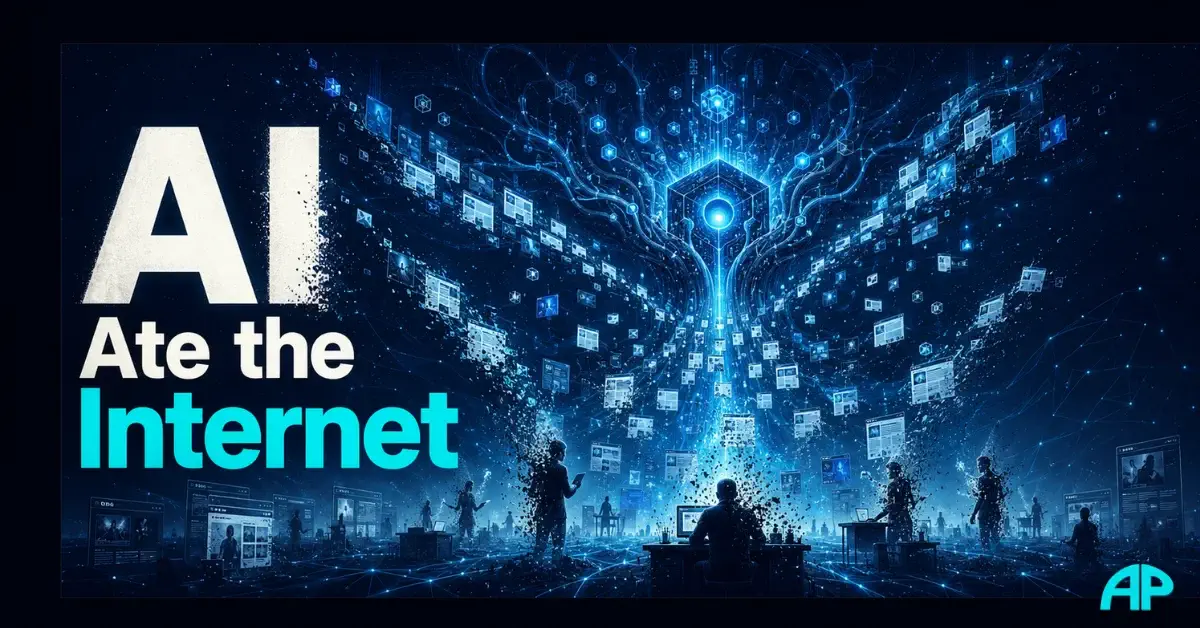
The more AI answers for us, the less reason people have to visit the websites that created the knowledge in the first place.
The more AI answers for us, the less reason people have to visit the websites that created the knowledge in the first place.
AI search and website traffic are moving in opposite directions. AI answers are becoming faster and more useful, while the independent websites supplying those answers are receiving fewer of the visits that once made publishing worthwhile.
I have watched the internet evolve since the late 1990s. In the beginning, a website felt like a place. You built something useful, search engines helped people find it, and visitors arrived at your digital front door.
They saw who created it and sometimes became subscribers, customers or returning readers.
The exchange was imperfect but clear.
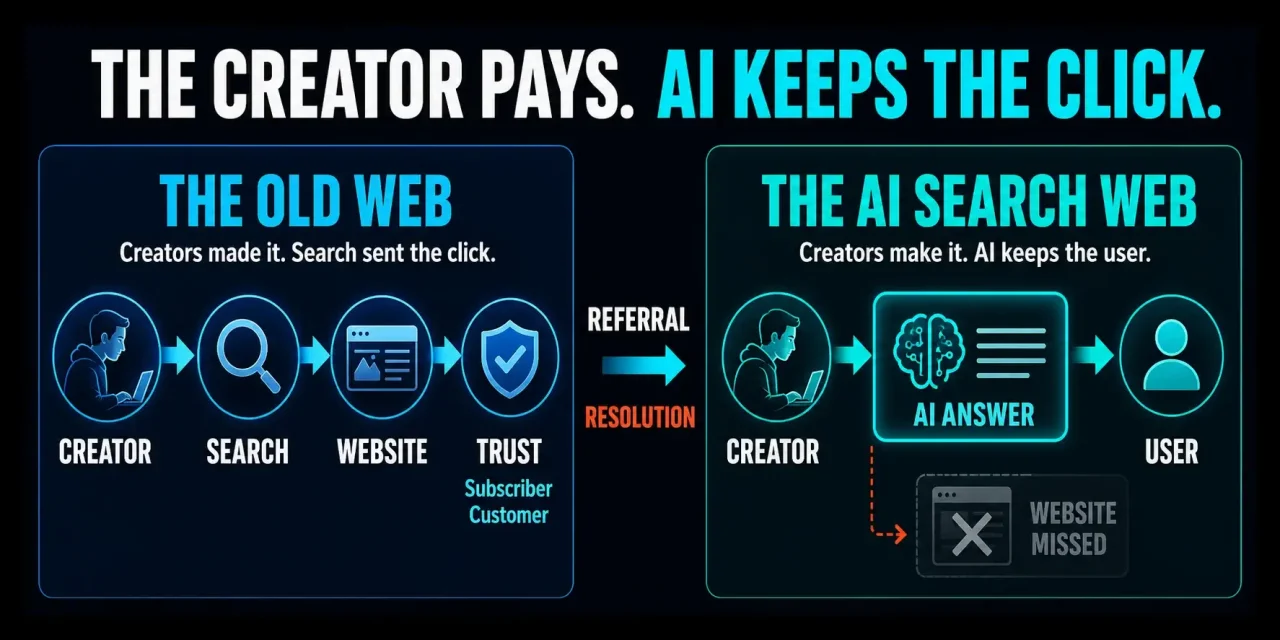
Creators produced the knowledge. Search engines distributed the attention.
AI search is rewriting that agreement. It no longer needs to send the user to the answer because it can absorb, combine and present the answer itself.
The reader gets the information.
The platform keeps the attention.
The creator quietly disappears.
Table of Contents
- The Bargain That Built the Web
- When Search Becomes the Answer
- The Click That Never Happens
- Who Pays for Original Knowledge?
- When the Web Feeds on Itself
- The Argument for AI Search
- Who Decides What Is True?
- How Independent Creators Survive
- The Web We Choose to Build
- Frequently Asked Questions
The Bargain That Built the Web
The early internet was awkward, but it gave ordinary people the ability to publish without asking permission.
A specialist could share hard-earned knowledge. A small business could compete with a larger company. A strong idea could build an audience from a spare bedroom.
Google organised the web and sent people towards useful pages. In return, websites allowed Google to crawl, index and understand their content.
Neither side created the entire value alone.
This referral bargain helped turn independent websites into businesses, libraries and communities. I explored that transformation in my article on the history of the internet.
Now, the bargain is changing.
When AI Search Becomes the Answer
Traditional search gave us a map.
AI search offers to take us directly to the destination, except we may never arrive at the original place.
Instead of presenting ten possible sources, an AI Overview can read several pages and deliver one smooth response. For many searches, that is exactly what people want.
Nobody enjoys opening five weak articles to find one useful paragraph. Website owners helped create this problem by publishing bloated, algorithm-first content.
AI search feels like a correction.
However, it also turns the website from a destination into background material used to construct an answer inside somebody else’s platform.
AI did not discover the knowledge.
It inherited it.
AI Search and Website Traffic: The Missing Click
The effect on clicks is becoming harder to ignore.
A Pew Research Center analysis found that users clicked a traditional result in 8% of Google visits when an AI summary appeared. When no summary appeared, they clicked a result in 15% of visits.
An answer on the results page can end the journey before it begins.
A 2026 working paper studied more than 161,000 matched Wikipedia article pairs. It estimated that exposure to Google AI Overviews reduced traffic to affected English-language pages by about 15%.
The decline was greatest where a short summary could satisfy the reader without requiring a deeper visit.
A July 2026 working paper found outbound clicks in only 5.2% of ChatGPT conversation sessions. It also estimated that wider access to ChatGPT Search reduced traditional search use by 9.4%.
Results will vary, but the direction is clear.
Search is gradually shifting from referral to resolution.
The Click That Never Happens
A lost click is not merely a number in Google Analytics.
It may be a relationship that never begins.
A visitor sees the thinking behind the answer. They notice your experience, tone and other work. Recognition can become trust.
As I explained in Why Trust Takes Time to Build Online, people rarely trust someone because of one clever sentence.
Trust grows through useful encounters repeated over time.
AI can remove the first encounter.
It can take the clearest insight from an article and give it to the reader without introducing the person who earned it.
The information survives.
The identity behind it does not.
That may be the most overlooked consequence of AI search.
The creator does not simply lose a visit. They lose the opportunity to be remembered.
Who Pays for Original Knowledge?
A genuine review may require weeks of testing. A travel guide requires someone to go there. A case study may represent years of work.
AI can compress that effort in seconds.
Yet it did not visit the destination, risk the money, conduct the experiment or live through the failure.
A person did.
Large publishers may negotiate licensing agreements or block AI crawlers. Independent creators have little leverage.
They can allow their work to be used and hope some visitors arrive, or they can restrict access and risk becoming invisible inside AI search altogether.
Neither option feels particularly fair.
When original work becomes less rewarding, some people will produce less of it. Others will use AI to create cheaper, faster content simply to remain visible.
The web may become fuller while becoming poorer.
There may be more pages, more articles and more words than ever before.
However, more content does not necessarily mean more knowledge.
When the Web Starts Feeding on Itself
As AI-generated content spreads, future systems will increasingly encounter material produced by earlier systems.
Original reporting becomes a summary. The summary becomes a rewritten article. That article becomes another AI answer.
The copy begins learning from the copy.
The danger is not that the internet suddenly collapses into nonsense. It is that information slowly loses texture.
Firsthand experience disappears. Uncertainty gets polished away. Original disagreement becomes one safe, averaged conclusion.
A confident answer replaces a complicated truth.
A 2026 study examined 98,020 individual claims in Google AI Overviews and found that 11% were unsupported by the pages cited alongside them.
That does not mean most AI answers are false.
It does show that polished language and visible citations do not automatically make an answer reliable.
Fluency can look like authority.
That is one of AI’s greatest strengths and one of its most dangerous weaknesses.
The Argument in Favour of AI Search
There is another side to this argument.
Google says AI search encourages people to ask more questions and that visitors who do click are often more engaged. It also says Google continues to send billions of clicks to the web each day.
That deserves to be taken seriously.
AI can explain difficult subjects, compare options and help people reach useful information faster. It may also surface specialist pages that never ranked near the top of traditional search.
The old web was not a golden age. It was cluttered with copied ideas, aggressive advertising and padded articles.
Therefore, the problem is not that AI provides answers.
The problem begins when the system extracts more value than it returns.
AI is not the enemy of the open web.
An unhealthy incentive structure is.
Who Decides What Is True?
Traditional search was never neutral. Algorithms, authority, commercial interests and optimisation all influenced rankings.
However, a page of search results still showed that alternatives existed.
An AI answer often presents one finished interpretation.
Somebody has decided which sources matter, which details can be ignored and how confidently the conclusion should be stated.
Most users never see those choices.
They simply see the answer.
Therefore, AI search is no longer merely organising information. It is becoming an editor of reality at an enormous scale.
The danger is not only that websites receive less traffic.
It is that people may receive a filtered version of the web while believing they have received the web itself.
How Creators Can Protect Website Traffic
Creators cannot force search engines back to the old model.
We must make the source more valuable than the summary.
Generic facts are easy to reproduce. Original experience is not.
Publish the test you conducted, the mistake you made, the result you observed and the opinion you can defend.
Give people something that would not exist without you.
A recognisable brand also matters. In the age of AI, your brand becomes a defence against becoming invisible.
Information is abundant.
Judgement, reputation and personality remain scarce.
Creators must also build direct relationships. Search traffic is borrowed until the reader chooses to stay connected. That is why an email list remains a digital asset you control.
Finally, build a body of work.
After publishing more than 500 blog posts, I have learned that each useful article adds another doorway into your thinking. I explored that effect in 500 Blog Posts Later.
AI may summarise an article.
It cannot easily summarise a reputation earned over years.
The Web We Choose to Build
AI search and website traffic do not have to remain in conflict.
A healthier system could provide clearer attribution, more meaningful referrals, stronger creator controls and fair ways to compensate original work.
However, that future will not appear automatically.
If AI platforms capture the knowledge, attention, advertising and user relationship while creators carry the cost, the web will slowly become more extractive and less alive.
For a while, users may not notice. The answers will still arrive instantly and sound polished.
Yet underneath, fewer people may be doing the difficult work that creates something genuinely new.
That is the contradiction at the centre of AI search and website traffic.
AI can make knowledge easier to access while making original knowledge harder to sustain.
The danger is not that AI will know too much.
The danger is that human beings will gradually lose the reason to create the things AI knows anything about.
Frequently Asked Questions
Is AI Search Reducing Website Traffic?
Research suggests that AI summaries can reduce clicks to external websites, especially for straightforward informational searches.
However, the effect varies according to the topic, platform, website and search intent.
Will AI Replace Websites?
No. People will still visit websites for products, services, tools, communities, trusted opinions, detailed research and firsthand experience.
Generic informational pages are likely to face the greatest pressure.
Is SEO Still Worth Doing?
Yes. The relationship between AI search and website traffic is changing SEO, not ending it.
The strongest strategy combines original content, a recognisable brand, natural internal linking and direct audience relationships.