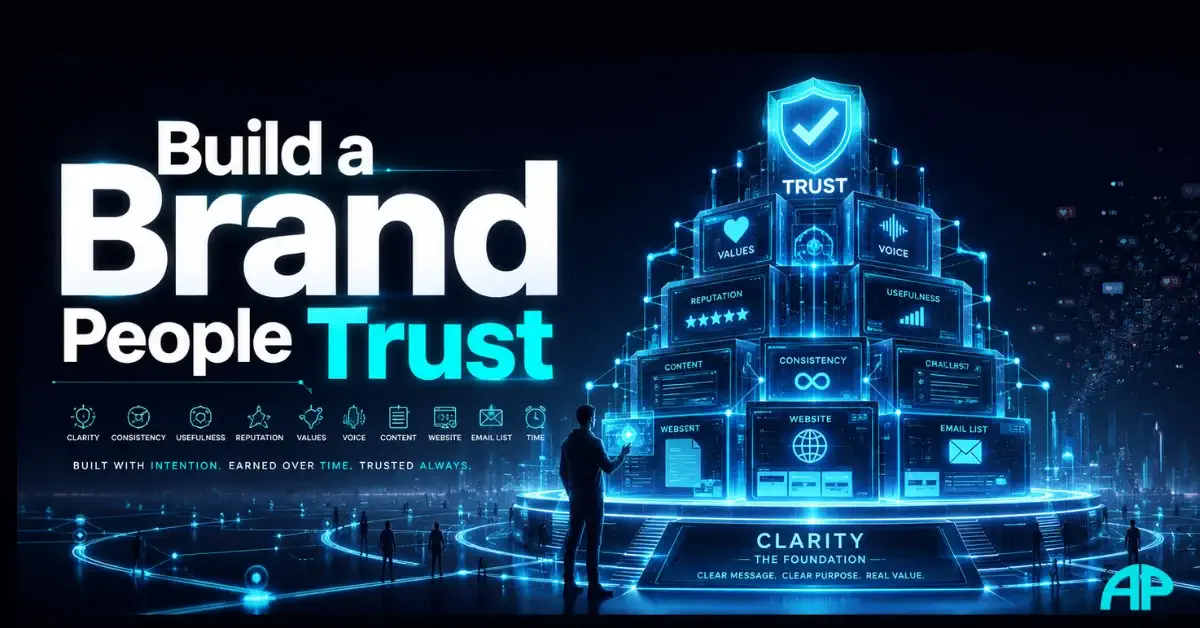
A practical beginner’s guide to building trust, content, audience, and digital assets online.
Table of Contents
- How to Build Your Brand Online
- Start With Your Message
- Know Who You Are Speaking To
- Build a Website You Control
- Create Useful Content
- Build an Email List Early
- Use AI Without Losing Your Voice
- Be Consistent Long Enough
- Build Digital Assets
- Show What You Stand For
- Make the Next Step Clear
- Build Before You Need It
- Start Simple and Keep Going
Most people make building a brand online far more complicated than it needs to be.
They think they need the perfect logo.
The perfect colours.
The perfect photos.
The perfect website.
The perfect niche.
The perfect content plan.
The perfect confidence.
So, they wait.
And while they are waiting, nothing grows.
No trust.
No audience.
No reputation.
No body of work.
No email list.
No digital assets.
No momentum.
However, the truth is much simpler.
If you want to know how to build your brand online, start with this:
Be clear about who you are, who you help, what you stand for, and why people should trust you.
Then keep showing up with useful content until people begin to understand, remember, and believe you.
That is the foundation, and it is where real online brand building begins.
It is not glamorous.
It is not instant.
However, it works.
Because, in the end, a real brand is not built from decoration. It is built from trust.
Start With Your Message
Before you worry about design, social media, funnels, videos, or AI tools, first get clear on your message.
Your message is the thread that holds your brand together.
It tells people what you are about.
It helps them understand why they should pay attention.
It gives your content direction.
It also stops you from sounding scattered.
For example, a simple brand message should answer a few basic questions:
Who do you help?
What do you help them with?
Why does it matter?
What do you believe?
What do you want to be known for?
You do not need to answer these perfectly on day one.
However, you do need a starting point.
For example, your message might be about helping people build a personal brand, use AI wisely, create digital assets, or start building a more independent online future.
That message can sharpen over time.
In fact, it probably will.
However, without a clear message, your brand becomes a collection of random content.
And random content rarely builds trust.
So, before you try to be everywhere, get clear on what you are really trying to say.
Know Who You Are Speaking To
Next, remember that a strong brand is not for everyone.
That may sound obvious, but many beginners get this wrong.
They try to speak to everybody.
As a result, they connect deeply with nobody.
If you want to build your brand online, you need to know who you are trying to help.
Not in a stiff marketing-avatar way.
In a real way.
What are they struggling with?
What do they want?
What are they afraid of?
What do they already know?
What are they confused about?
What do they need to hear, but may not be hearing anywhere else?
When you understand your audience, your content becomes sharper.
Your examples become more relevant.
Your offers become clearer.
Your emails become easier to write.
Most importantly, people start to feel that you “get” them.
That matters because relevance builds trust faster than noise.
People do not trust a brand because it talks loudly.
They trust a brand because it understands them.
Build a Website You Control
Of course, social media can help people discover you.
However, your website should be your home base.
It is one of the most important digital assets you can build because it gives your brand a place you control.
Your website does not need to be complicated.
But it does need to be clear.
When someone lands on your website, they should quickly understand:
Who you are.
What you help with.
Who you help.
Why they should trust you.
What they should do next.
That is the job, and it should be obvious within seconds.
Your website can hold your best content, your story, your offers, your email sign-up, your resources, and your contact details.
Unlike social media, your website is not just a feed.
It is a structure.
It can be organised.
It can be searched.
It can rank in Google.
It can collect leads.
It can explain your thinking.
It can work while you sleep.
That is why, over time, a website becomes more than an online brochure.
It becomes part of your brand foundation.
Create Useful Content
In many ways, content is how people get to know you before they know you.
It is how they experience your thinking.
It is how they decide whether you are useful.
It is also how they begin to trust you.
However, useful content is not just content that fills space.
Useful content helps someone.
It answers a question.
It explains a problem.
It gives clarity.
It helps someone make a better decision.
It makes them feel less overwhelmed.
It gives them a reason to come back.
If you are wondering how to build your brand online, useful content is one of the most important answers.
Because every helpful blog post, email, video, guide, or resource gives people another reason to believe you may be worth paying attention to.
This does not mean you need to post everywhere.
You do not need to chase every platform.
You do not need to become a content machine.
Instead, start with one strong channel.
For many people, that should be your website and blog.
Then, you can repurpose that content into emails, social posts, videos, or community discussions.
Ultimately, the goal is not to make noise.
The goal is to build trust in public.
Build an Email List Early
Another big mistake people make is waiting too long to build an email list.
They focus on traffic.
They focus on followers.
They focus on views.
However, they often forget to build a direct relationship with the people who are interested.
An email list gives you that direct line.
When someone joins your list, they are saying, “I want to hear more from you.”
That is valuable.
Of course, you need to respect that trust.
Do not treat your email list like an ATM.
Do not send nothing for months and then appear only when you want to sell.
Instead, use email to build the relationship.
Share useful ideas.
Send new content.
Tell stories.
Explain what you are learning.
Invite people deeper into your world.
Over time, as trust grows, your email list can become one of your most valuable digital assets.
Because followers can disappear.
Algorithms can change.
Platforms can limit your reach.
But an email list gives you a direct connection with your audience.
Use AI Without Losing Your Voice
At the same time, AI can be a powerful tool for online brand building.
It can help you plan content.
It can help you generate ideas.
It can help you structure blog posts.
It can help you research topics.
It can help you improve clarity.
It can help you repurpose content.
It can also help you stay consistent.
However, AI should support your brand.
It should not become your brand.
That distinction matters.
People do not trust generic content.
They trust real thinking.
They trust lived experience.
They trust judgement.
They trust voice.
So, use AI to reduce friction.
Use it to organise your thoughts.
Use it to turn rough ideas into drafts.
Use it to create outlines, headlines, emails, and content plans.
However, always bring yourself back into the work.
Add your story.
Add your examples.
Add your opinions.
Add your standards.
Add the phrases only you would say.
Because while AI can help you build faster, your voice is what makes the brand feel real.
Be Consistent Long Enough to Be Remembered
Admittedly, consistency is not exciting.
But it is one of the biggest reasons brands grow.
People trust what they see repeatedly.
They begin to recognise your message.
They begin to understand your point of view.
They begin to expect value from you.
And eventually, they begin to remember you.
That is when brand trust starts to build, even if the results are not obvious at first.
The problem is that most people stop too soon.
They publish a few posts.
They send a few emails.
They get little response.
Then they assume nothing is working.
However, trust often builds quietly before it shows up publicly.
People may be reading without commenting.
They may be watching without liking.
They may be deciding whether you are real.
That is why consistency matters so much.
Not frantic consistency.
Not posting all day.
Not burning yourself out.
Just steady, useful, repeated presence.
Show up.
Help.
Refine.
Repeat.
That is how your brand begins to stick.
Build Digital Assets, Not Just Posts

For instance, a post can disappear in a day.
An asset can keep working for years.
That is the difference, and it changes how you think about content.
If you want to understand how to build your brand online, think beyond daily posts.
Think in terms of assets.
A helpful blog post is an asset.
A clear homepage is an asset.
An email list is an asset.
A free guide is an asset.
A content library is an asset.
A community can be an asset.
A strong personal brand can be an asset.
The more useful assets you build, the stronger your online foundation becomes.
This is where many people go wrong.
They keep feeding social media platforms but never build anything they control.
They keep chasing attention but never create something that compounds.
Instead, you want to build pieces that connect.
Your website supports your content.
Your content supports your email list.
Your email list supports trust.
Your trust supports your offers.
Your offers support your business.
When these pieces work together, your brand becomes much more than a name.
It becomes a system.
Show People What You Stand For
Also, your brand is not only what you know.
It is also what you stand for.
People want to know your values.
They want to know how you think.
They want to know what you believe.
They want to know what lines you will not cross.
That does not mean you need to be controversial for the sake of it.
It does not mean you need to turn every post into a personal confession.
However, it does mean you should not be bland.
A brand with no point of view is easy to forget.
So, wherever possible, be clear.
If you believe trust matters more than hype, say it.
If you believe people should build before they need results, say it.
If you believe AI should support human voice, not replace it, say it.
If you believe digital assets matter more than vanity metrics, say it.
Your values help people decide whether they belong in your world.
That is a good thing.
The right people will lean in.
The wrong people may leave.
As a result, your brand becomes stronger because it becomes more honest and recognisable.
Make the Next Step Clear
Finally, a brand should not leave people confused.
After someone reads your content, visits your website, or connects with your message, they should know what to do next.
That next step might be:
Read another article.
Join your email list.
Download a guide.
Join your community.
Book a call.
Buy a product.
Reply to an email.
Importantly, the next step does not always need to be a sale.
In fact, it often should not be.
Sometimes the best next step is simply to deepen trust.
That is why your brand needs a clear pathway.
People should be able to move from stranger to reader, from reader to subscriber, from subscriber to believer, and from believer to buyer or community member.
Do not make them work too hard to figure it out.
Yes, clarity helps conversion.
But more importantly, clarity respects the reader.
Build Your Brand Before You Need It
Unfortunately, many people only start building their brand when the pressure arrives.
They need clients now.
They need traffic now.
They need income now.
They need people to trust them now.
However, trust does not work on demand.
It needs time.
It needs repeated proof.
It needs useful content.
It needs consistency.
That is why I believe you should build your brand before you need it, because building trust, content, and reputation takes time.
If you start early, you give your message time to sharpen.
You give your content time to rank.
You give your audience time to grow.
You give your email list time to develop.
You give your reputation time to form.
And most importantly, you give trust time to build naturally.
Ultimately, that is the smarter path.
Start Simple and Keep Going
You do not need to build everything at once.
You do not need to have the perfect brand strategy.
You do not need to feel ready.
You do not need to become famous.
Instead, you just need to start with the right foundations.
Get clear on your message.
Know who you want to help.
Build a website you control.
Create useful content.
Start your email list.
Use AI wisely.
Stay consistent.
Build digital assets.
Show people what you stand for.
Make the next step clear.
That is how to build your brand online in a real, practical way, without making it harder than it needs to be.
Not with gimmicks.
Not with fake authority.
Not with noise.
But with clarity, usefulness, trust, and time.
If this message hits home, The Brand Makers is where we take this further.
It is a free community for people who want to build a brand, use AI with purpose, create digital assets, and shape their future before they urgently need results.