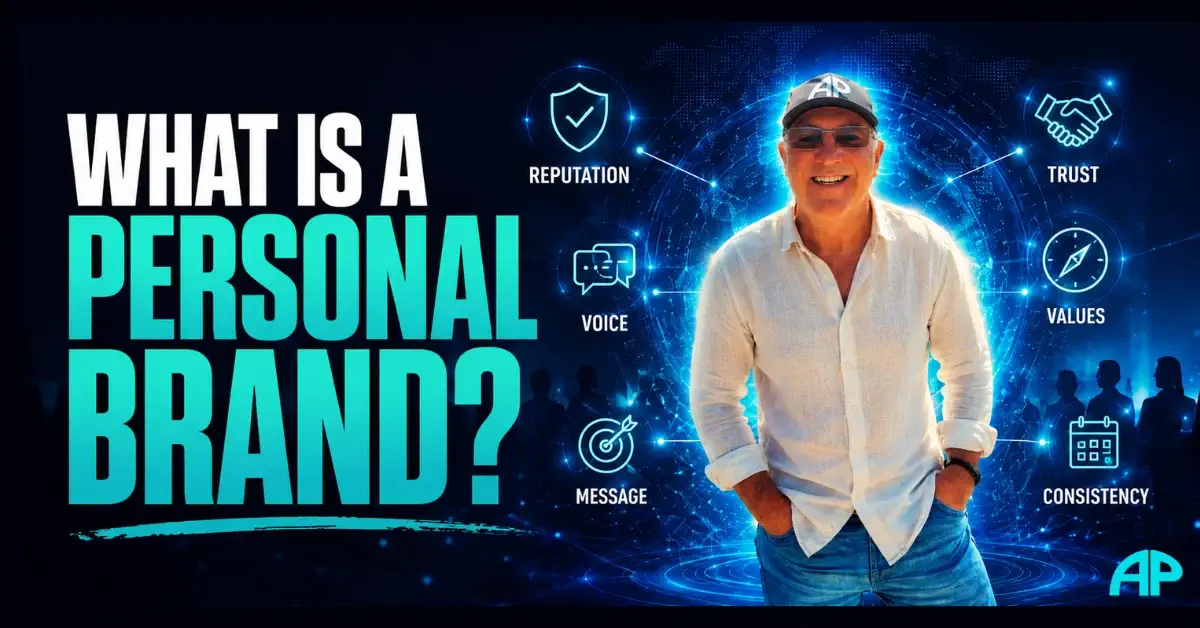
Your personal brand is not your logo. It is what people believe about you.
Table of Contents
- What Is a Personal Brand?
- What a Brand Is Not
- Why Your Brand Matters
- The 5 Core Parts:
- Simple Brand Examples
- How to Start
- Build Before You Need It
What Is a Personal Brand?
A personal brand is what people believe about you before you enter the room.
That might sound dramatic, but it is true.
Before someone speaks to you, buys from you, follows you, subscribes to your list, reads your blog, watches your video, or books a call, they already have a feeling about you.
That feeling comes from what they have seen.
Your words.
Your actions.
Your content.
Your reputation.
Your values.
Your consistency.
This is why personal branding matters.
However, a personal brand is not just a logo. It is not just a nice website. It is not a polished profile photo or a clever tagline.
Those things may support your brand, but they are not your brand.
Instead, your personal brand is the reputation, message, trust, and feeling people associate with your name.
And whether you realise it or not, you already have one.
Therefore, the real question is simple.
Are you shaping your personal brand on purpose, or are you leaving it to chance?
What Is a Personal Brand?
So, what is a personal brand?
A personal brand is the way people understand, remember, and describe you.
It is what they believe you stand for.
It is also what they expect from you.
In many ways, it is the reason they either pay attention or keep scrolling.
Your personal brand answers questions like:
What are you known for?
What do you care about?
What problems do you help solve?
Why should someone trust you?
What kind of person do people believe you are?
A strong personal brand gives people clarity.
As a result, they know what you talk about.
They know what you stand for.
They know what kind of value you bring.
Most importantly, they know whether you are someone worth listening to.
That does not mean you need to be famous.
It also does not mean you need to be loud.
And it certainly does not mean you need to become some polished online character.
In fact, the strongest personal brands are usually built around truth, clarity, usefulness, and consistency.
Your personal brand is not what you say about yourself once.
Instead, it is what people come to believe about you over time.
That is the important part.
Anyone can make a claim.
For example, anyone can say they are experienced, trustworthy, creative, reliable, honest, or helpful.
However, your personal brand is built when your actions support those claims again and again.
What a Personal Brand Is Not
Personal branding has been made more complicated than it needs to be.
For many people, the phrase instantly brings up images of influencers, staged photos, fancy logos, perfect colours, and fake online confidence.
But that is not real branding.
That is decoration.
A personal brand is not your logo.
It is not your colour palette.
It is not your social media template.
It is not pretending to be someone you are not.
It is not copying someone else’s style because it seems to be working for them.
And it is not about posting motivational quotes every morning and hoping people suddenly trust you.
Those things are surface level.
They might help present your brand, but they do not create trust by themselves.
A strong personal brand does not make you fake.
Instead, it makes you clearer.
It helps people understand who you are, what you care about, what you know, and why they should pay attention.
That distinction matters.
Because too many people avoid building a personal brand because they think it means becoming something artificial.
However, it does not.
It means becoming more intentional about how you show up.
It means taking the raw material of who you are and communicating it more clearly.
Your story.
Your experience.
Your skills.
Your lessons.
Your values.
Your way of seeing the world.
That is where the real power is.
Why Your Personal Brand Matters
We live in a noisy world.
Everyone is publishing.
Everyone is posting.
Everyone is selling something.
Everyone is trying to get attention.
However, attention by itself is not enough.
Trust is what matters.
People may notice you once because of a clever headline, a viral post, or a strong image.
But they come back because they trust the signal.
In other words, they feel there is something solid behind it.
That is where your personal brand becomes powerful.
A strong personal brand helps people remember you.
It also gives your content direction.
It makes your message easier to understand.
As a result, it helps people decide whether you are someone they want to follow, learn from, work with, buy from, or recommend.
This matters even more now because of AI.
AI can create content.
AI can create images.
AI can help build websites.
AI can also help with research, planning, writing, and productivity.
However, AI cannot fully copy your lived experience.
It cannot copy your real story.
It cannot copy the years you have spent learning lessons the hard way.
It cannot copy your judgement.
It cannot copy your values.
And it cannot copy the trust you earn by showing up honestly over time.
Therefore, in the age of AI, your personal brand may become one of the few things that cannot be copied properly.
That is why your personal brand matters.
Because when content becomes easier to produce, trust becomes more valuable.
People will not just ask, “Is this information useful?”
Instead, they will ask, “Who is this coming from?”
That is the shift.
Your personal brand gives your words weight.
The 5 Core Parts of a Personal Brand
A personal brand is not built from one thing.
Instead, it is built from several parts working together.
Here are five of the most important.
1. Reputation
Your reputation is what people already believe about you.
Are you reliable?
Are you honest?
Are you useful?
Do you follow through?
Do you explain things clearly?
Do people feel better informed after dealing with you?
Your reputation is not built through clever marketing.
Instead, it is built through repeated behaviour.
If you say one thing and do another, people notice.
On the other hand, if you show up consistently, people notice that too.
Reputation is slow to build and easy to damage.
That is why it sits at the centre of personal branding.
Before someone trusts your offer, they usually need to trust you.
2. Message
Your message is the main idea you want to be known for.
This is where many people get stuck.
They talk about too many things at once.
They jump from topic to topic.
As a result, they confuse the audience because they are not clear themselves.
A confused message creates a confused audience.
Your message does not need to be perfect from day one.
However, it does need direction.
For example, your message might be about helping people build a brand.
It might be about using AI with purpose.
It might be about creating digital assets.
It might be about building a freedom based online business.
Or it might be about helping people start again and take control of their future.
The more clearly you can explain your message, the easier it is for people to understand why they should listen.
In other words, your message is the thread that ties your content together.
Without it, you are just making noise.
3. Values
Your values show people what you stand for.
Not in a stiff corporate mission statement way.
Instead, in a real way.
Values show up in what you say yes to.
They also show up in what you refuse to support.
They show up in the way you speak.
They show up in the type of people you want to help.
And they show up in the lines you will not cross.
For example, your values might include freedom, truth, independence, creativity, discipline, personal responsibility, family, health, courage, or building something real.
Whatever they are, they give your personal brand backbone.
Without values, a brand feels hollow.
It may look good on the surface, but people sense there is nothing underneath.
A strong personal brand has substance.
Most importantly, it stands for something.
4. Voice
Your voice is how you sound.
Some people are calm and thoughtful.
Some are direct and blunt.
Some are funny.
Some are analytical.
Some are warm and encouraging.
Others are raw, honest, and straight to the point.
However, there is no single correct voice.
The mistake is borrowing a voice that does not belong to you.
For example, if you are naturally direct, do not try to sound like a soft corporate brochure.
If you are naturally thoughtful, do not force yourself to be loud and edgy.
And if you are naturally practical, do not bury your message under fancy language.
Instead, your personal brand should sound like you on your clearest day.
Not fake.
Not forced.
And not polished to the point where all the life has been squeezed out of it.
Your voice helps people feel who they are dealing with.
That matters.
Because people do not connect with bland.
They connect with real.
5. Consistency
Consistency is what turns a message into trust.
People trust what they see repeatedly.
Not once.
Not randomly.
Repeatedly.
However, this does not mean you need to post every hour of the day.
It also does not mean you need to become a content machine.
Instead, it means your message, behaviour, tone, and values need to line up over time.
If you talk about freedom one day, then act like a victim the next, people notice.
If you talk about discipline but never finish anything, people notice.
And if you talk about trust but constantly exaggerate, people notice.
Consistency is not glamorous.
But it is powerful.
You do not build a personal brand in one big dramatic moment.
Instead, you build it through small signals repeated over time.
That is why I believe you should build your brand before you need it.
Trust is much harder to create when you are already desperate for attention, leads, or income.
Simple Personal Brand Examples
A personal brand does not need to be complicated.
For example, the local plumber who turns up on time, explains the job clearly, cleans up after himself, and does not rip people off has a personal brand.
The business owner who shares honest lessons from the trenches also has a personal brand.
The coach who gives practical advice without pretending life is perfect has a personal brand too.
Likewise, the blogger who consistently writes helpful content about affiliate marketing, AI, branding, and digital assets has a personal brand.
However, the person who complains online, changes direction every week, attacks everyone, and never follows through also has a personal brand.
Just not a good one.
That is the thing most people miss.
Personal branding is not optional.
You are always sending a signal.
Your silence sends a signal.
Your inconsistency sends a signal.
Your content sends a signal.
Your attitude sends a signal.
And your work ethic sends a signal.
Therefore, your personal brand is being built either way.
The smart move is to start shaping it deliberately.
How to Start Building Your Personal Brand
You do not need to have everything figured out before you start.
In fact, waiting until everything is perfect is one of the biggest traps.
You build clarity by moving.
You build confidence by doing.
And you build trust by showing up before anyone is clapping.
Start simple.
First, decide what you want to be known for.
Next, choose the audience you want to help.
Then get clear on the problems you understand.
After that, share what you are learning.
Also, tell the truth from your own experience.
Create content that helps people think, act, or see something more clearly.
At the same time, build a simple home base, ideally your own website.
Then start collecting email subscribers.
Most importantly, keep showing up.
That is the foundation.
You do not need to be the world’s leading expert.
However, you do need to be useful.
You do need to be honest.
You do need to be consistent.
And you do need to care enough to keep improving.
That is where a real personal brand begins.
Build the Brand Before the World Needs Proof
Most people wait too long.
They wait until they need clients.
They wait until they need traffic.
They wait until they need income.
They wait until they need attention.
Then they suddenly realise they have no audience, no trust, no message, no digital assets, and no clear position in the market.
That is a hard place to start from.
A personal brand works best when it is built before the pressure arrives.
Before you need the sale.
Before you need the opportunity.
Before you need people to believe you.
Because trust takes time.
And the best time to start building trust is before you urgently need it.
So, what is a personal brand?
It is not decoration.
It is not vanity.
And it is not pretending to be someone you are not.
Instead, your personal brand is digital trust.
It is your reputation, message, values, voice, and consistency working together over time.
And if you build it with honesty, purpose, and patience, it can become one of the most valuable assets you ever create.
If this idea hits home, The Brand Makers is where we take it further.
It is a free community for people who want to build a brand, use AI with purpose, create digital assets, and start shaping their future instead of waiting for permission.