A simple step-by-step checklist to help you build a clear, trusted personal brand online.
Table of Contents
- What You Want Known For
- Who You Want to Help
- Write a Simple Message
- Identify Your Core Values
- Develop Your Brand Voice
- Build a Website You Control
- Create Useful Content
- Start Your Email List Early
- Show Proof Over Time
- Keep Your Brand Consistent
- Build Digital Assets
- Start Before You Feel Ready
Building a personal brand can feel overwhelming at first.
After all, it is easy to think you need a perfect website, polished photos, a clever tagline, a big social media following, and a fully planned content strategy before you begin.
However, that is not true.
A strong personal brand starts much simpler than that.
It starts with clarity.
Clarity about who you are.
Clarity about who you help.
Clarity about what you believe.
Clarity about why people should trust you.
From there, your personal brand grows through consistency, usefulness, honesty, and time.
That is why this personal branding checklist for beginners is not about pretending to be someone you are not. Instead, it is about helping you organise what is already there, so people can understand you faster and trust you more easily.
Because, in the end, your personal brand is not your logo.
It is not your colours.
It is not your profile photo.
Those things can support your brand, but they are not the brand itself.
Your personal brand is the impression people build about you over time.
It is what they believe about your knowledge, values, personality, standards, usefulness, and reliability.
So, if you want to build a personal brand online, start with the foundations.
1. Clarify What You Want to Be Known For
First, get clear on what you want people to associate with you.
Not in a fake, manufactured way.
In a real way.
Do you want to be known for helping beginners understand online business?
Do you want to be known for clear thinking around AI, branding, content, or digital assets?
Do you want to be known for practical experience, honest advice, calm guidance, or long-term strategy?
At the beginning, you do not need to choose something painfully narrow.
However, you do need direction.
Without direction, your content becomes scattered. One day you post about one thing. The next day you post about something completely unrelated. As a result, people struggle to understand what you are about.
And when people are confused, trust becomes harder.
So, begin with this question:
What do I want people to remember me for?
Your answer may change over time, and that is fine. However, you need a starting point.
2. Define Who You Want to Help
Next, get clear on who your brand is for.
This does not mean you need to invent a stiff marketing avatar with a fake name, age, and favourite coffee order.
Instead, think about the real person you want to help.
What are they trying to do?
What are they struggling with?
What are they tired of hearing?
What do they need explained more clearly?
What mistake are they likely to make?
What result are they hoping for?
The better you understand the person you are speaking to, the easier your content becomes.
For example, your words become sharper.
Your examples become more relevant.
Your offers become more useful.
Most importantly, people feel understood.
And when people feel understood, they are far more likely to trust you.
This is one of the most important parts of any personal branding checklist for beginners, because a personal brand is not just about you. It is also about the people you serve.
3. Write a Simple Brand Message
Once you know who you help, the next step is to write a simple brand message.
Your brand message does not need to be clever.
In fact, clever often gets in the way.
A good brand message should be clear.
It should explain who you help, what you help them with, and why it matters.
For example:
“I help beginners build trusted online brands through clear content, useful digital assets, and practical AI support.”
That is not fancy.
However, it is clear.
A simple brand message gives your website, content, emails, and social profiles a centre of gravity.
It helps people understand you quickly.
Also, it helps you stay focused when creating content.
Start with this simple structure:
I help [who] do [what] so they can [benefit].
Then refine it over time.
You do not need to get it perfect today.
You just need to get it clear enough to start.
4. Identify Your Core Values
After that, think about your values.
Your values shape your brand more than you may realise.
They influence how you write.
They influence what you talk about.
They influence what you avoid.
They also influence the kind of people you attract.
For example, your values might include honesty, independence, usefulness, simplicity, consistency, freedom, personal responsibility, or long-term thinking.
When you know your values, your brand becomes more grounded.
You are less likely to chase every trend.
You are less likely to copy what everyone else is doing.
You are also less likely to say things just because they sound good.
Instead, your content begins to have a point of view.
And that matters.
Because a personal brand with no values feels flat.
However, a personal brand with clear values feels human.
5. Develop a Recognisable Voice
Next, pay attention to your brand voice.
Your brand voice is how people experience your personality through your words.
It does not need to be loud.
It does not need to be polished to death.
It also does not need to sound like everyone else in your industry.
Actually, it should not.
Your voice should sound like a clear, useful, trustworthy version of you.
Are you direct?
Are you calm?
Are you practical?
Are you encouraging?
Are you slightly blunt?
Are you reflective?
Are you more teacher, guide, strategist, mentor, or storyteller?
Once you understand your natural voice, protect it.
Do not let AI flatten it.
Do not let templates strip it out.
And do not let corporate language make you sound lifeless.
People connect with people.
So, even when you use tools, systems, and content frameworks, your voice should still feel real.
6. Build a Website You Control
Of course, social media can help.
However, your personal brand needs a home base.
Your website gives you control.
It allows you to explain who you are, what you do, what you believe, and how people can go deeper.
At a basic level, your website should include:
Your homepage.
Your about page.
Your best content.
A clear email sign-up.
A way to contact you.
A simple next step.
Your website does not need to be huge.
However, it does need to be clear.
When someone lands on your site, they should quickly understand what you are about.
If they have to work too hard, they will leave.
So, think of your website as a trust asset.
It is not just there to look good.
Instead, it is there to make your message easier to understand and easier to believe.
7. Create Useful Content Consistently
Once your foundations are clear, start creating useful content.
Content is how your personal brand becomes visible.
It is how people discover your thinking.
It is also how they learn from you before they ever buy from you, join your list, or reach out.
However, useful content is not random posting.
Useful content helps people move forward.
It might answer a common question.
It might explain a confusing topic.
It might challenge a bad assumption.
It might give someone a simple next step.
Or it might help them see a problem more clearly.
This is where content consistency matters.
You do not need to publish every day.
You do not need to be everywhere.
However, you do need a steady rhythm.
For example, you might publish one strong blog post each week. Then you might turn that post into an email, a few short social posts, or a simple video.
That way, your content becomes a system.
Over time, your content library becomes one of your most valuable digital assets.
8. Start Building Your Email List Early
Another important step is building your email list early.
Many beginners leave email too late.
They focus on followers, views, likes, and traffic.
However, they forget to build a direct relationship with the people who are interested.
An email list gives you that direct connection.
It means someone has raised their hand and said, “I want to hear more from you.”
That is valuable.
So, do not wait until everything is perfect.
Start simple.
Offer a useful guide, checklist, short email series, resource, or update.
Then send helpful emails consistently.
You can share new content, useful ideas, behind-the-scenes lessons, personal stories, recommendations, or invitations.
The goal is not to sell constantly.
Instead, the goal is to build trust.
Because when people hear from you regularly and find your emails useful, your personal brand becomes more familiar and more credible.
9. Show Proof Over Time
Trust needs proof.
Not hype.
Not empty claims.
Not exaggerated promises.
Proof.
However, proof does not always mean flashy results.
Proof can come in many forms.
It might be your body of work.
It might be your experience.
It might be case studies.
It might be testimonials.
It might be results.
It might be thoughtful content published over a long period of time.
It might even be the way you explain something clearly when others make it confusing.
For beginners, proof often starts with consistency.
You may not have a long list of testimonials yet.
You may not have big results to show.
However, you can still show proof through effort, clarity, usefulness, and honest progress.
That matters more than most people realise.
Because people are watching for signals.
They want to know if you are serious.
They want to know if you are helpful.
They also want to know if you are likely to still be here next month, next year, and beyond.
10. Keep Your Brand Consistent
Consistency does not mean being boring.
Instead, it means being recognisable.
Your message should feel consistent.
Your values should feel consistent.
Your voice should feel consistent.
Your visuals should feel consistent.
Your content themes should feel consistent.
When everything keeps changing, people struggle to place you.
However, when your brand feels consistent, people begin to remember you.
That is when trust starts to compound.
This does not mean you can never evolve.
Of course you can.
In fact, your brand should evolve as you grow.
But evolution is different from confusion.
So, use this personal branding checklist for beginners as a simple way to keep the important pieces aligned.
Your message.
Your audience.
Your values.
Your voice.
Your website.
Your content.
Your email list.
Your proof.
Your consistency.
When these pieces work together, your brand becomes easier to understand and easier to trust.
11. Build Digital Assets, Not Just Attention
Attention can disappear quickly.
For example, a post can get views today and vanish tomorrow.
A social media platform can change its algorithm.
A trend can fade.
A profile can be restricted.
However, digital assets can keep working.
A strong article can rank in search.
A good email list can build relationships.
A clear website can convert visitors.
A useful guide can bring in subscribers.
A content library can create authority.
A trusted personal brand can open doors.
That is why your goal should not only be to get attention.
Instead, your goal should be to build assets.
Assets give your brand weight.
They make your work easier to find, easier to share, and easier to build on.
Most importantly, they give your personal brand something solid beneath it.
12. Start Before You Feel Ready
Finally, start before you feel ready.
This is where many people get stuck.
They wait until they feel confident.
They wait until their website is perfect.
They wait until their niche is perfectly defined.
They wait until they have more experience.
They wait until they know exactly what to say.
However, clarity often comes from doing.
Confidence often comes from publishing.
And trust often comes from showing up before anyone is paying much attention.
That is why I believe you should build your brand before you need it, because a trusted personal brand is easier to grow before pressure arrives.
If you wait until you urgently need clients, traffic, income, attention, or opportunity, you will be trying to build trust under pressure.
That is much harder.
Instead, start now.
Start small.
Start honestly.
Start with the foundations.
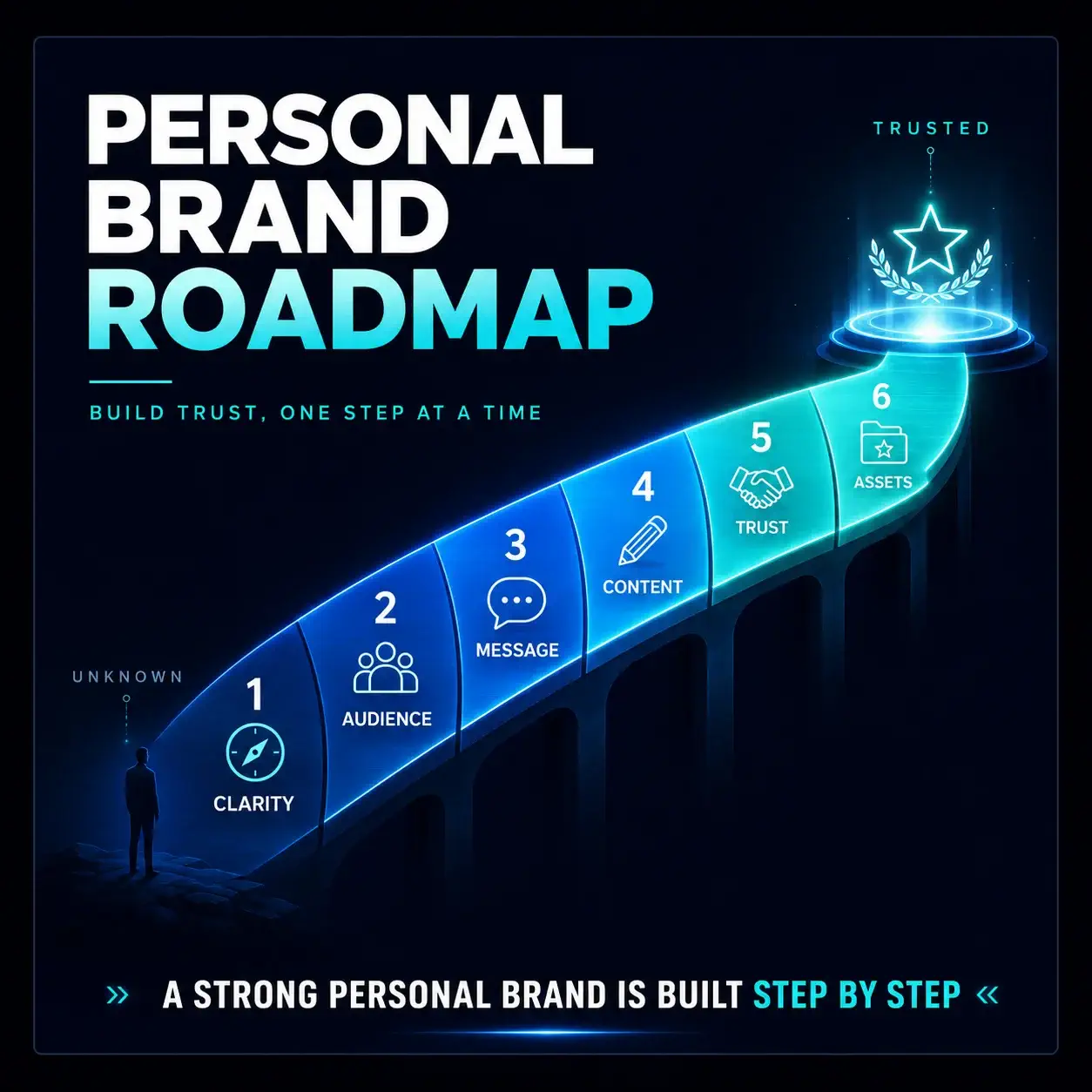
Personal Branding Checklist for Beginners
Here is the simple checklist again:
Clarify what you want to be known for.
Define who you want to help.
Write a simple brand message.
Identify your core values.
Develop a recognisable voice.
Build a website you control.
Create useful content consistently.
Start building your email list early.
Show proof over time.
Keep your brand consistent.
Build digital assets, not just attention.
Start before you feel ready.
Ultimately, this personal branding checklist for beginners is not about creating a fake image.
It is about becoming easier to understand, easier to remember, and easier to trust.
That is the real work.
Not pretending.
Not performing.
Not chasing every trend.
Instead, it is about building something honest, useful, and strong enough to grow over time.
Because your personal brand is not built in one post, one logo, one website, or one clever line.
It is built through repeated proof.
It is built through useful content.
It is built through clear values.
It is built through consistency.
And most of all, it is built before you urgently need it.
Take the Next Step With The Brand Makers
If this personal branding checklist for beginners has helped you see the bigger picture, the next step is to keep building with the right people around you.
That is where The Brand Makers comes in.
The Brand Makers is a free community for people who want to build a personal brand, use AI with purpose, create useful digital assets, and grow trust online before they urgently need results.
It is for people who want to stop waiting, get clearer, and start building something real.
Join The Brand Makers and start building your brand before you need it.