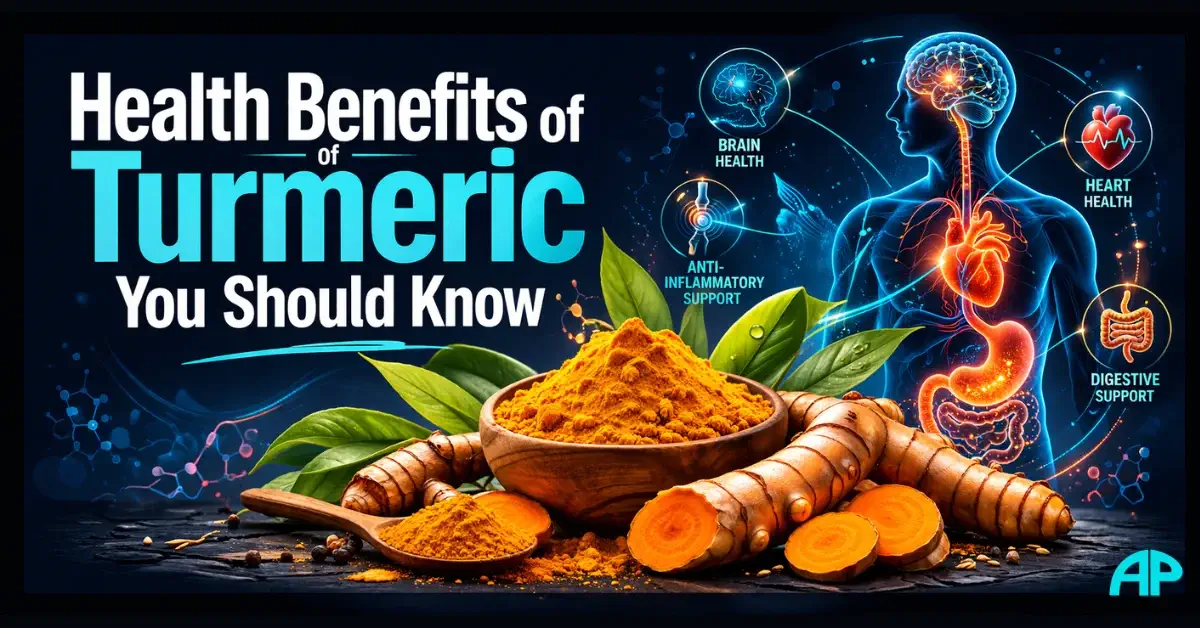
A clear guide to turmeric’s benefits, uses, and key health support areas
Last updated: April 2026
Table of Contents
- What Is Turmeric?
- Why Turmeric Gets Attention
- Anti Inflammatory Benefits
- Digestion and Gut Comfort
- Heart Health Support
- Brain Health and Clarity
- Curcumin Explained
- Why Absorption Matters
- How to Use Turmeric
- When to Be Careful
- Easy Ways to Add Turmeric
- Is Turmeric Worth It?
- Turmeric FAQs
Turmeric gets talked about everywhere.
Some people treat it like a miracle. Others dismiss it as hype.
The truth sits somewhere in the middle.
There are real reasons why turmeric has earned so much attention. At the same time, not every claim you read online deserves to be believed.
This guide breaks down the Health Benefits of Turmeric in a practical and balanced way. We will look at what turmeric may support, where the limits are, and how to use it wisely as part of a healthy routine.
What Is Turmeric and Why Has It Gained So Much Attention?
Turmeric is a bright yellow spice from the ginger family.
It has been used for centuries in cooking and traditional wellness practices. Today, it is also one of the most talked about ingredients in the natural health space.
A big reason for that is curcumin.
Curcumin is one of the main active compounds in turmeric. It is the part most often linked to turmeric’s potential health properties.
That matters because many people talk about turmeric when they are really talking about curcumin.
It is also worth knowing that whole turmeric and concentrated curcumin supplements are not the same thing. They are related, but they are not interchangeable.
Why Turmeric Continues to Get So Much Attention
Turmeric sits in an interesting position.
It feels both ancient and modern at the same time. It is a traditional ingredient, but it also fits neatly into today’s health and wellness conversation.
People are drawn to turmeric because it seems simple, natural, and easy to use.
It can be added to meals, stirred into drinks, or taken as a supplement. That makes it feel accessible.
Much of the interest around turmeric comes back to two things. Its anti inflammatory potential and its antioxidant properties.
That does not mean turmeric is magic.
It simply means there are valid reasons why it keeps showing up in conversations around everyday wellness.
Turmeric Anti Inflammatory Benefits and Everyday Wellness
Inflammation is one of those words that gets used a lot.
At its core, inflammation is part of the body’s natural response to stress, irritation, or injury. In the short term, that response has a job to do.
The bigger concern is ongoing inflammation over time.
This is where turmeric anti inflammatory benefits come into the picture.
Curcumin has attracted attention because of its anti inflammatory activity. That is one of the main reasons turmeric has become so popular in the health world.
Many people use turmeric as part of a broader wellness routine to support joint comfort, recovery, and general wellbeing.
That said, turmeric should not be treated like a quick fix.
It is far better to see it as one supportive tool within a bigger health picture. Sleep still matters. Food still matters. Movement still matters. So does stress management.
Turmeric may support the process, but it should not be sold as a miracle answer.
Turmeric Benefits for Digestion and Gut Comfort
One of the longest standing traditional uses of turmeric relates to digestion.
Long before it became a popular supplement, turmeric was used in food and herbal practices as part of digestive support.
That history is one reason it still gets mentioned today.
When people talk about turmeric benefits for digestion, they are usually talking about general gut comfort and digestive balance.
Some people enjoy adding turmeric to meals, warm drinks, or teas because it feels soothing and easy to work into daily life.
It can be a simple addition that supports a more intentional approach to health.
Still, digestion is highly individual.
What suits one person may not suit another. Some people may find turmeric helpful. Others may find that larger amounts or stronger supplements irritate the stomach instead of calming it.
That is why it makes more sense to think in terms of support, not certainty.
Turmeric Benefits for Heart Health: Support, Not Hype
Heart health is not something that hinges on one ingredient.
That is important to say clearly.
Too much health content online implies that one superfood or one supplement can do the heavy lifting. It cannot.
Good heart health still comes back to the basics. Food quality. Sleep. Movement. Stress. Lifestyle. Medical guidance when needed.
Still, there is a reason people discuss turmeric benefits for heart health.
Turmeric is often mentioned because of the wider conversation around inflammation and oxidative stress. This has made it a point of interest for people who want to support overall cardiovascular wellbeing.
The smarter way to frame turmeric is as a supportive ingredient.
It may have a place in a healthy lifestyle, but it should never be oversold.
That balanced perspective is far more useful than hype.
Turmeric Benefits for Brain Health and Mental Clarity
Brain health is now a much bigger conversation than it used to be.
More people are thinking about memory, focus, mental sharpness, and cognitive wellbeing as they age.
That has led to growing interest in foods and compounds that may support the brain over time.
This is where turmeric benefits for brain health often get mentioned.
Curcumin has drawn attention because inflammation and oxidative stress are often discussed in connection with cognitive decline.
That makes turmeric an interesting topic.
It does not mean turmeric is a shortcut to better memory or sharper thinking overnight.
It is better viewed as one small part of a long term brain-supportive lifestyle that also includes proper sleep, movement, mental stimulation, and decent nutrition.
That is the grounded take.
Curcumin Explained: Why It Matters So Much
If turmeric is the headline, curcumin is often the reason behind it.
Curcumin is the best known active compound in turmeric. It is the part that gets the most attention in research and in supplement marketing.
This helps explain why turmeric gets so much credit for a wide range of possible benefits.
It also explains why not all turmeric products are equal.
The amount of curcumin can vary depending on the product, the extract, and how it is formulated.
That means two turmeric products may look similar on the surface, but offer very different experiences.
This is one reason online conversations about turmeric can become confusing.
People are often talking about different forms without realising it.
Why Absorption Matters When Using Turmeric
One of the biggest issues with turmeric is absorption.
Curcumin is not easily absorbed by the body on its own. That means it is not just about what you take. It is also about how you take it.
This is why many products include black pepper extract or suggest taking turmeric with fat.
These are common ways used to improve absorption.
It is also why some supplements may work differently from others.
Cooking with turmeric can still be valuable. It can absolutely be part of a healthy routine.
But using turmeric in food is not exactly the same as taking a concentrated supplement designed for higher absorption.
That distinction matters.
It helps people think more clearly about what they are actually using and why.
How to Use Turmeric in a Practical Way
The good news is turmeric does not need to become another complicated ritual.
In many cases, the simplest approach is the best one.
You can use turmeric in curries, soups, rice dishes, roasted vegetables, eggs, smoothies, and warm drinks.
That may be enough for many people.
It keeps turmeric connected to real life instead of turning it into another health trend that gets dropped after a week.
Some people prefer capsules or supplements.
That can make sense too, especially if convenience matters or if they want a more measured intake.
If you go down that path, quality matters.
So does common sense.
Start simply. Stay consistent. Pay attention to how you respond.
That is a much better approach than jumping from product to product chasing hype.
When Turmeric May Not Be the Right Fit
This is the part many fluffy health posts leave out.
Natural does not automatically mean harmless.
Turmeric may be useful, but it still needs to be used with a bit of thought.
Some people may experience digestive discomfort, reflux, nausea, or stomach upset, especially with stronger supplements or larger amounts.
Not everyone responds the same way.
There is also the issue of medication interactions.
People taking blood thinning medication, those with certain health conditions, or anyone already using multiple supplements should be more careful.
That does not mean turmeric is bad.
It simply means it should be used sensibly.
If you are unsure, it makes sense to speak with a qualified health professional before going heavy on any supplement.
This section matters because it keeps the article honest.
It also makes the rest of the page more credible.
Simple Ways to Add Turmeric to Your Routine
If you want to keep it easy, turmeric can fit into normal life without much fuss.
You can stir it into soups, mix it through rice, use it in curries, add it to roasted vegetables, or blend it into smoothies.
Some people like it in warm drinks.
Others prefer it in egg dishes or simple home cooked meals.
If the taste is not for you, a supplement may be the easier option.
Either way, the point is not to be extreme.
The point is to be consistent.
Small habits done regularly are usually more useful than random bursts of enthusiasm.
Is Turmeric Worth Adding to Your Routine?
Turmeric has earned its place in the health conversation for a reason.
There is enough interest around inflammation, digestion, heart health, brain health, and curcumin itself to justify the attention.
At the same time, turmeric works best when it is kept in perspective.
Turmeric is not magic.
It will not replace good habits.
It is certainly not a shortcut around poor lifestyle choices.
That breaks the repetition and still keeps the punch.
What it may offer is support.
Support for people who are already trying to live better.
Support as part of a routine built around decent food, movement, sleep, and smarter choices.
For many people, that is where turmeric fits best.
Not as hype.
Not as fantasy.
Just as one useful tool in a bigger commitment to health.
Frequently Asked Questions About Turmeric
What are the main health benefits of turmeric?
The main areas people usually talk about are inflammation, digestion, heart health, and brain health.
Much of the interest centres on curcumin, which is the compound most often linked to turmeric’s potential health properties.
Does turmeric help with inflammation?
That is one of the biggest reasons turmeric gets attention.
The phrase turmeric anti inflammatory benefits is so common because curcumin is widely discussed in relation to inflammation.
The key is to see turmeric as supportive, not miraculous.
Is turmeric good for digestion?
Many people use turmeric as part of a digestive support routine.
That is why turmeric benefits for digestion are often mentioned in health content.
Still, people respond differently, so it is best to keep expectations realistic.
Can turmeric support brain health?
There is growing interest in turmeric benefits for brain health because of the wider conversation around inflammation, oxidative stress, and cognitive wellbeing.
That said, turmeric should be seen as one possible support tool, not a miracle fix.
Is turmeric good for heart health?
People often discuss turmeric benefits for heart health because turmeric is linked to the broader conversation around inflammation and overall wellbeing.
The smart approach is to view it as supportive within a healthy lifestyle.
What is the best way to take turmeric?
That depends on your goal.
Some people are happy using turmeric in food and drinks. Others prefer supplements for convenience and consistency.
Either way, absorption matters, and quality matters.
Are there any side effects of turmeric?
Yes, there can be.
Some people may experience stomach upset, reflux, nausea, or digestive discomfort, especially with stronger supplements or larger amounts.