Why slowing down, asking questions, and thinking for yourself matters more than ever
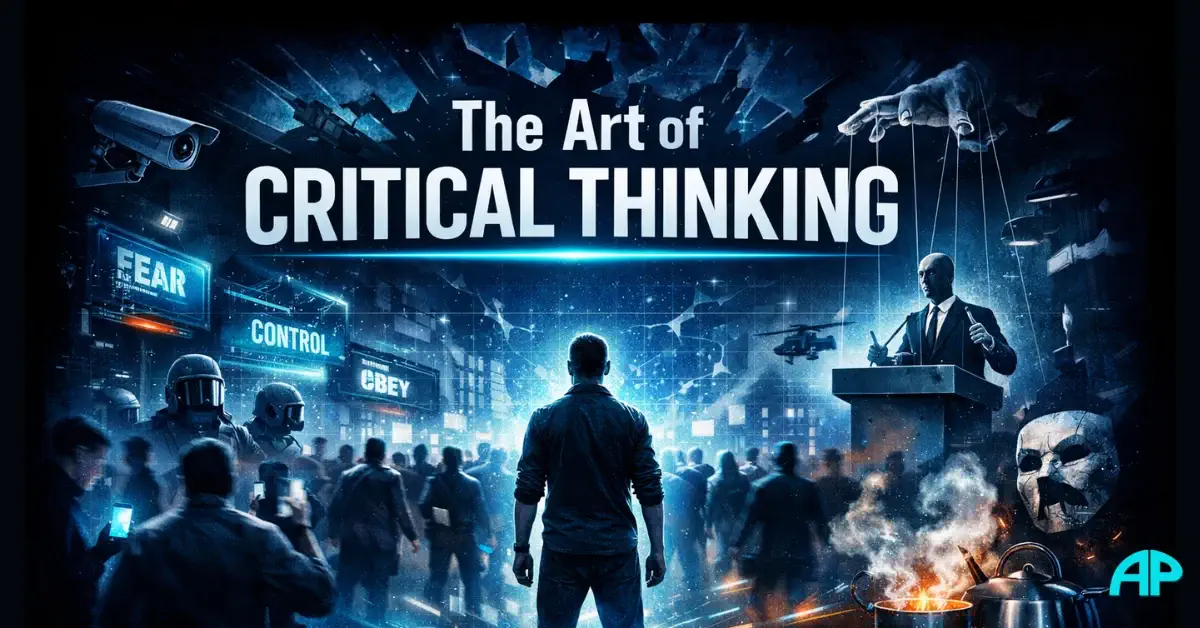
The Art of Critical Thinking matters more now than ever.
We live in a world full of noise. Full of spin. Full of emotion. Full of pressure. Full of narratives designed to steer people, shape opinion, and keep the average person reacting instead of thinking.
That is why critical thinking matters.
Not blind rebellion.
Not arguing for the sake of it.
Not pretending to know everything.
Just the ability to slow down, step back, ask better questions, and look a little deeper before swallowing the official line whole.
In simple terms, The Art of Critical Thinking is the habit of pausing before you believe, reacting before you understand, or agreeing before you have actually looked. It is about learning to think for yourself in a world that constantly tries to think for you.
What a learning curve the last six years have been.
My God, so much has happened. Not just in my personal life, but politically, globally, and socially. Everywhere you look, something has shifted. Something has been exposed. Something has been pushed. And the deeper you dig, the more obvious it all becomes.
Table of Contents
- Why Critical Thinking Matters
- When Things Started Shifting
- Questioning the Moon Story
- Why Asking Questions Matters
- Media Manipulation at Work
- Thinking for Yourself Again
- What Covid Really Revealed
- Fear Pressure and Obedience
- Why We Must Not Forget
- The Frog in Boiling Water
- The Real Art of Thinking
- How to Think More Critically
- Strange Moments That Hit
- What This Taught Me
- Where I Stand Now
- Frequently Asked Questions
Why Critical Thinking Matters
While a lot of this really started falling into place for me in earnest about six years ago, that does not mean I had no sense before then that things were off. I already had concerns, especially around big pharma. What I had not fully grasped was just how deep the tentacles of control really went.
That is the thing with this sort of journey.
It rarely happens all at once.
It is not usually one giant lightbulb moment where everything suddenly makes perfect sense. It is more like a slow stacking of moments. One question leads to another. One inconsistency catches your eye. One detail nags at you. One story does not sit right. Then another. Then another.
Eventually, something shifts.
You start realising that a lot of what we are told is not there to inform us. It is there to shape us. To steer us. To condition us. To keep us reactive, divided, distracted, and dependent.
That is when The Art of Critical Thinking stops being some abstract idea and starts becoming a real skill you use in everyday life.
When Things Started Shifting
I will never forget having a bit of fun with one bloke at a business networking meeting about four years ago. I questioned whether man had really gone to the moon. Not because I claimed to know for sure, but because I was willing to ask the question. That was all it took. From there on in, I was branded the flat earther.
Funny how that works.
Ask one uncomfortable question and suddenly people want to shove you into a neat little box.
Questioning the Moon Story
Not that I knew for sure. It was just one of those things I had never really paid much attention to, but I was starting to question the narrative. And that hit me in a strange way, because I remember very clearly being just a kid, sitting there with my dad, watching the so-called moon landing. We were excited. It felt like a huge moment. So to later start questioning whether it was all bullshit was, in some ways, quite a shock to the system.
Then somebody pointed out the space capsule and it just clicked. I remember looking at it and thinking, look at this, mate. It’s made of tin foil. From there I dug a bit deeper, watched a few videos, and the more I looked into it, the harder it became to believe we had really been to the moon.
For the record, I am not a flat earther. I do not know enough about that subject either way. But that is kind of the point.
If this line of thinking resonates, it also connects naturally with my posts on What’s Outside the Simulation? and Freedom in the Age of Deepfakes: Truth or Total Illusion?.
Why Asking Questions Matters
The Art of Critical Thinking is not about pretending to know everything.
It is about being willing to admit when something does not add up. It is about being honest enough to say, I do not know, but I am willing to look. It is about resisting the pressure to rush toward a conclusion simply because everyone else already has.
I have never felt the need to jump on every official story just because it is popular or because everyone else has already decided what is true. I would rather look. I would rather question. I would rather sit with things and take my time before making up my mind.
Usually, if you give something enough time and look closely enough, you can smell the bullshit.
That is where the real journey begins.
Media Manipulation at Work
Because once you start seeing manipulation, you cannot unsee it. Once you notice how one-sided the mainstream media is, how heavily managed the narratives are, and how often emotion gets used in place of truth, it changes the way you see the world.
You start hearing the same language repeated everywhere.
You start noticing how stories are framed.
You start noticing which voices get amplified and which voices get buried.
You start noticing how quickly people are mocked, silenced, or branded when they ask the wrong questions.
That is not healthy.
That is not free thinking.
That is not truth seeking.
That is narrative management.
And it is everywhere.
There is just so much going on in the world right now.
Look at Lebanon.
Look at the weather manipulation.
Look at the disasters.
Look at the energy infrastructure being destroyed all around the place.
Is it not obvious?
Apparently not.
Or maybe, for a lot of people, it is easier not to see it.
Maybe it is easier to stay comfortable. Easier to trust the script. Easier to believe someone else is taking care of things. Easier to stay inside the official story than step outside it and risk being judged, mocked, or isolated.
This section sits naturally alongside my broader thoughts on media control and hidden agendas and the illusion of freedom.
Thinking for Yourself Again
That is exactly why independent thinking matters.
That is exactly why critical thinking skills matter.
Not reacting emotionally to every headline.
Not swallowing every official story without question.
Not defending the narrative just because challenging it feels uncomfortable.
Not mocking people for asking questions simply because those questions sit outside the mainstream.
We need to slow down.
We need to ask better questions.
We need to look deeper.
We need to think for ourselves again.
Because without critical thinking, people become incredibly easy to manipulate.
And if the last few years taught us anything, it is that manipulation works frighteningly well on people who have forgotten how to think beyond the script.
What Covid Really Revealed
That is one reason I cannot stand how casually people now say we should all just move on from the Covid era.
Yes, in life there are times when moving on is healthy.
But forgetting is something else entirely.
And I think many people have forgotten far too quickly what that period revealed.
Too many people seem to have forgotten the corruption, the lies, the deceit, the censorship, the hypocrisy, the bullying, the coercion, and the role corrupt politicians played through all of it.
We should never have brushed that aside like it was nothing.
That era revealed a lot.
It showed how quickly fear could be weaponised.
It showed how easily they could bury the truth.
It showed how willing institutions were to crush open discussion.
It showed how fast people were willing to turn on each other.
It showed how many leaders were either too weak, too compromised, or too corrupt to stand up for what was right.
Fear Pressure and Obedience
And people forget what actually happened here in Australia.
I remember Canberra. I remember the protests. I remember Melbourne. I remember Victoria.
All in the name of a vaccine that, as far as I am concerned, caused more damage than good.
I remember police firing rubber pellets and pepper rounds into protesters. I remember the arrests, the force, and the feeling that the police had turned on ordinary people in a way many Australians had never seen before.
What Daily Life Felt Like
I also remember what day-to-day life felt like during that era. Going through the Covid years and refusing to wear a mask or get vaccinated really did make people go crazy. I remember going to the supermarket and people looking at me sideways as if I were some kind of criminal. I remember coughing once in Aldi, just a small cough, and I swear the whole store went silent and looked at me.
Fear Turned People Against Each Other
That is how deep the fear ran.
Fear drove people, and it made them irrational. It made them suspicious. It made them obedient. It made them turn on each other.
And that is exactly what happened.
That is why the politicians and all the mouthpieces who pushed and spruiked that bullshit during that time have a lot to answer for. They were not working for the average everyday person. They fed the panic, fed the division, and helped create an atmosphere where ordinary people were treated like threats for simply making a different choice.
I remember people being shouted down for asking questions.
I remember people being treated like criminals for pushing back.
I remember businesses, families, friendships, and communities being torn apart.
I remember the ugliness of it.
And I remember the censorship.
YouTube channels. Accounts deleted. People silenced. People threatened. Voices shut down for daring to question the narrative.
It was hideous.
Why We Must Not Forget
And yet people seem to have forgotten.
That worries me.
Because since the Covid days, a lot has changed, and not all of it has been obvious. A lot of it has happened slowly. Quietly. Bit by bit. Layer by layer.
That is the real danger.
The Frog in Boiling Water
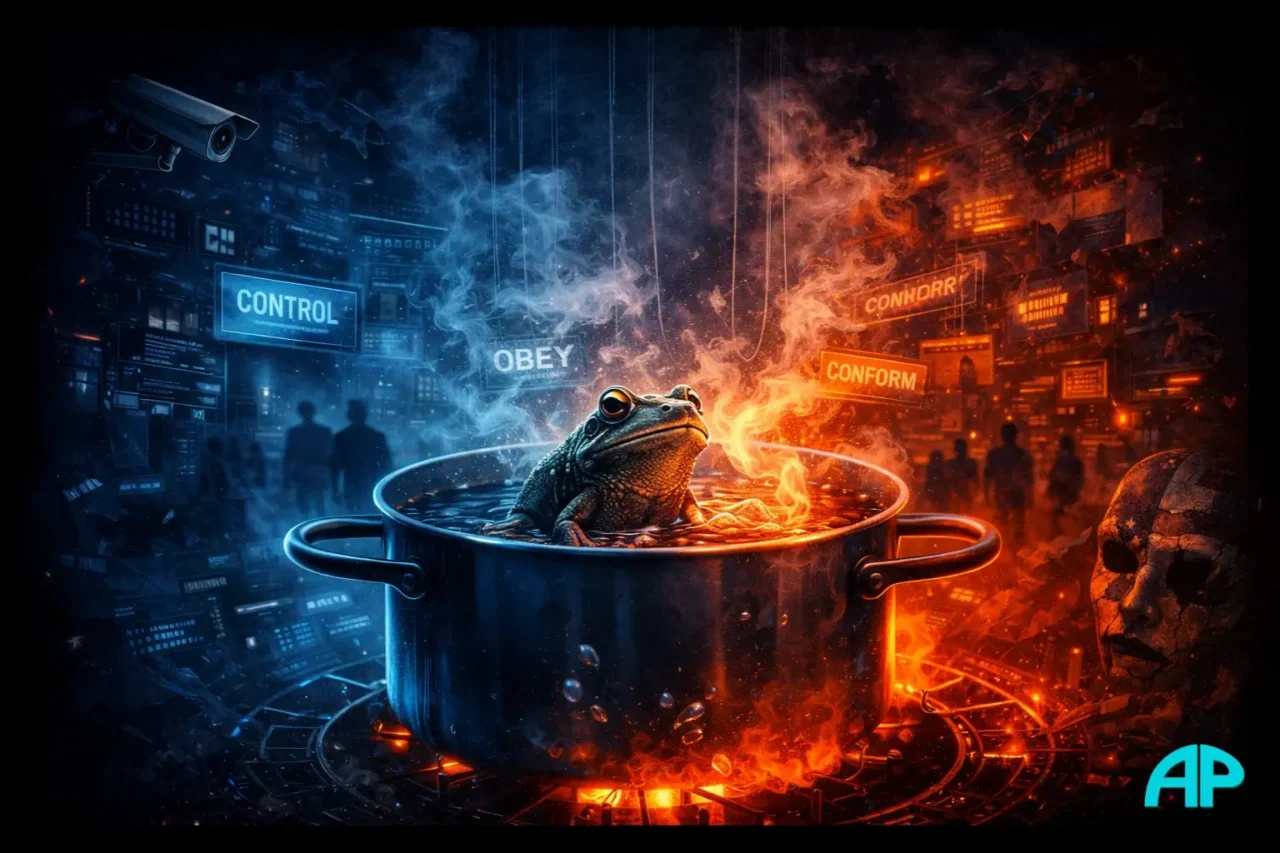
It is like the frog in boiling water. The heat does not come all at once. It gets turned up slowly.
A little more censorship.
A little more surveillance.
A little more media spin.
A little more manipulation.
A little more pressure to conform.
A little less freedom.
A little less privacy.
A little less truth.
And because it happens gradually, most people barely notice.
We are being slowly cooked, and most people still think the water is fine.
That, to me, is one of the biggest lessons from the last few years.
The real danger is not always the headline event.
Sometimes the real danger is what gets normalised afterwards.
People now shrug off what once would have shocked them. They now normalise what once would have raised outrage. They now package what once would have sounded insane as progress, safety, convenience, or the greater good.
That is how control works when it is done well.
Not always in one giant move.
Sometimes through slow conditioning. Through repetition. Through distraction. Through fatigue. Through getting people used to things they never should have accepted in the first place.
The Real Art of Thinking
That is why The Art of Critical Thinking matters so much.
Because critical thinking helps you pause when everyone else is rushing. It helps you step back when everyone else is reacting. It helps you question the narrative when everyone else is repeating it. It helps you see media manipulation for what it is. It helps you think for yourself in a world that is constantly trying to think for you.
That is not rebellion for the sake of it.
That is self-preservation.
That is maturity.
That is discernment.
That is personal sovereignty.
How to Think More Critically
This is where The Art of Critical Thinking becomes practical.
You do not need to become a scholar. You do not need to know everything. You just need to build better habits.
Start by slowing down before reacting.
Notice when a headline is trying to provoke fear or outrage.
Ask who benefits from the story being framed a certain way.
Compare multiple sources instead of leaning on one.
Pay attention to what gets left out, not just what gets said.
Be willing to say, I do not know yet.
That last one matters more than most people realise.
A lot of bad thinking comes from people rushing to certainty too quickly.
The Art of Critical Thinking often starts with enough humility to admit that something feels off, even if you cannot fully explain it yet.
Strange Moments That Hit
At the same time, life keeps throwing up strange little moments that make you stop and think.
I have had the opportunity recently to try a new health device. I will just call it that for now. Supposedly it is incredibly powerful and based on energy. I am not going to say too much about it yet, but if it goes well I will share more in time.
I showed it to a friend’s wife today. She has a condition that this device may potentially help with, but she was not really interested. She did say the technology is certainly getting better, but that was about it.
And then on the same day we are fed another story about going around the moon again. More theatre. More propaganda. More nonsense.
To me, it is absolute bullshit.
We are being strung along in ways most people still do not begin to grasp. And while yes, some people can see it, most still cannot. They just do not have the eyes to see and the ears to hear.
That makes me sad.
What This Taught Me
Not because I think I know everything. I do not. Far from it.
But because I know enough to know when something is off. I know enough to know when a narrative feels forced. I know enough to know when questioning something gets punished more than the lie itself. And I know enough to know that too many people have handed over their ability to think critically in exchange for comfort and consensus.
That is not wisdom.
That is surrender.
This whole journey has taught me a lot.
It has taught me to trust my instincts more.
It has taught me to look deeper.
It has taught me not to rush.
It has taught me to be comfortable standing alone in a room if I have to.
It has taught me that being mocked for asking questions is often a sign you are too close to something people do not want examined.
It has taught me that truth does not always arrive neatly packaged or socially approved.
Sometimes it arrives awkwardly.
Sometimes it makes people uncomfortable.
Sometimes it costs you socially.
Sometimes it leaves you standing outside the herd.
So be it.
I would rather ask questions than blindly obey. I would rather sit in uncertainty than pretend certainty where none exists. I would rather think for myself than borrow my worldview from the nightly news.
That, to me, is The Art of Critical Thinking.
It is not about ego.
It is not about always being right.
It is not about acting smarter than everyone else.
It is about staying awake.
Staying curious.
Staying honest.
Staying grounded.
And refusing to hand your mind over to people who have not earned your trust.
Where I Stand Now
This is an interesting journey, that is for sure.
At times it feels like we are living inside some kind of 3D movie. A scripted reality. A stage show with layers upon layers of distraction, manipulation, and illusion. And yet right in the middle of it all, there is still something powerful available to each of us.
Awareness.
Discernment.
Critical thinking.
Memory.
Courage.
Because once you start paying attention, once you stop outsourcing your mind, once you stop needing approval for every thought, you start seeing things differently.
And once you see it, you cannot unsee it.
That is where I am at.
Still questioning.
Still watching.
Still learning.
Still thinking for myself.
And proud of it.
Frequently Asked Questions
What is The Art of Critical Thinking?
The Art of Critical Thinking is the habit of slowing down, asking better questions, and thinking for yourself instead of blindly accepting popular narratives or emotionally charged headlines.
Why does critical thinking matter so much today?
Critical thinking matters because we live in an environment shaped by fear, media manipulation, political spin, and constant pressure to conform. It helps people stay grounded and make better judgments.
How can I improve my critical thinking skills?
You can improve your critical thinking skills by slowing down, questioning the narrative, comparing sources, watching for emotional manipulation, and admitting when you do not know enough yet.
Is critical thinking the same as being negative?
No. Critical thinking is not negativity. It is not cynicism for the sake of it either. It is careful, honest thinking that looks deeper before accepting something as true.
Why is thinking for yourself important?
Thinking for yourself matters because people become easy to manipulate when they stop questioning, stop reflecting, and hand their judgment over to institutions, headlines, or group pressure.