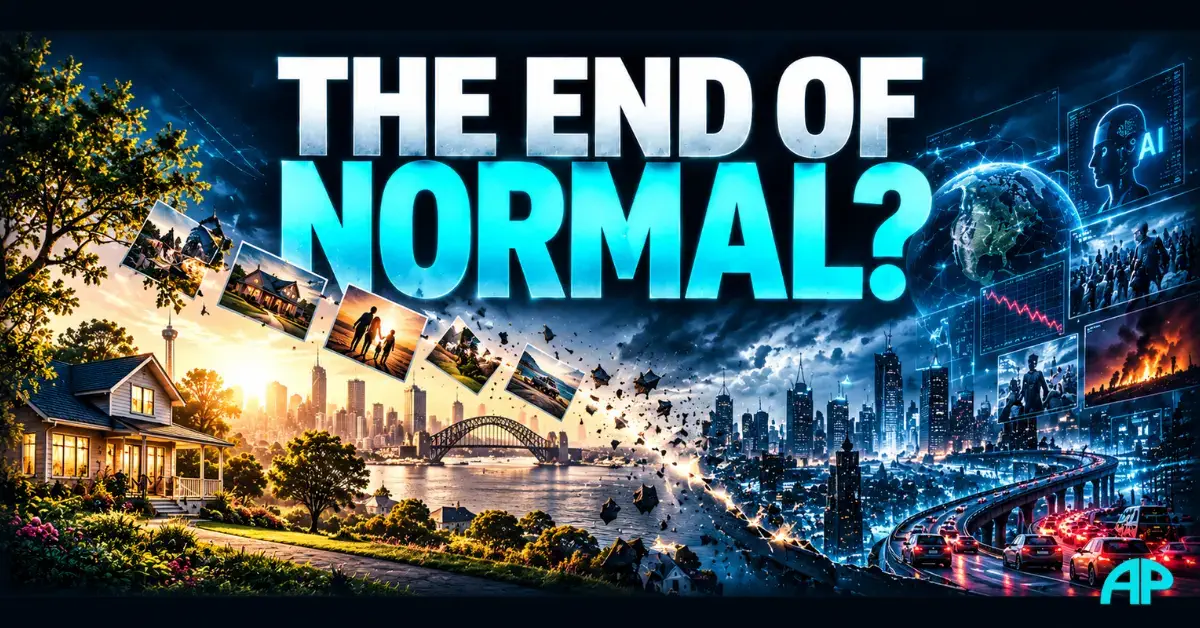
Something fundamental is changing. The life we once considered normal is becoming harder to afford, harder to predict and, for many, harder to believe in.
Not the certainty that life will always work out. Anyone who’s been around long enough knows that’s nonsense.
I’m talking about the confidence that the effort you put in today will mean something tomorrow.
For years, people made decisions based on that belief.
They started businesses, committed to mortgages, changed careers and planned for retirement.
There were risks, of course. But the future seemed reasonably predictable.
Now consider the questions people are asking.
Will artificial intelligence replace my job?
Will I ever afford a home?
Will my savings last through retirement?
Will my children enjoy the opportunities I had?
These questions influence more than financial decisions.
They influence how we live.
People become cautious. They postpone commitments. They stay in jobs they dislike because taking a chance feels too dangerous.
And slowly, something changes inside us.
We stop asking what’s possible and start concentrating on what’s safe.
Perhaps the biggest thing we’re losing isn’t money. It’s the confidence to imagine a better future.
The World Has Moved Into Our Heads
Here’s something else worth considering.
We’re carrying the problems of the entire planet around in our pockets.
Think about that.
A hundred years ago, most people knew relatively little about what was happening beyond their immediate communities.
Today, before you’ve finished your morning coffee, you can absorb more bad news than previous generations might have encountered in weeks.
War. Crime. Political conflict. Economic uncertainty. Natural disasters. Predictions of technological upheaval.
And tomorrow?
Another collection of reasons to worry.
Being informed is important. But there’s a difference between understanding what’s happening and becoming emotionally consumed by it.
Social media makes that distinction increasingly difficult.
Fear attracts attention. Anger generates engagement. Outrage keeps people scrolling.
Meanwhile, ordinary life rarely makes headlines.
Nobody sends you a notification because millions of people had a perfectly pleasant day.
Yet those days still happen.
People fall in love. Children laugh. Strangers help one another. Families share meals. Communities come together.
The world contains extraordinary kindness alongside terrible suffering.
But our screens rarely give them equal attention.
So perhaps we need to ask ourselves something uncomfortable.
Is the world genuinely becoming darker, or have we created an information environment that makes its darkness impossible to escape?
The answer may be both.
Either way, constantly feeding our minds with fear changes how we experience life.
When People Stop Believing in the System
Financial pressure is one thing.
Feeling that nobody in authority is listening makes it worse.
Across Australia, people are increasingly questioning decisions surrounding housing, immigration, healthcare, crime and the cost of living.
These aren’t simply political talking points.
They’re issues affecting everyday lives.
People want somewhere affordable to live. They want safe communities, fair opportunities and the confidence that their concerns matter.
When those expectations aren’t met, frustration builds.
And frustration can quickly become resentment.
Suddenly, every problem needs someone to blame.
Politicians blame one another. Social media divides people into opposing camps. Complex issues become shouting matches.
Yet the underlying problems remain.
A healthy society needs more than functioning institutions.
It needs trust.
Trust that the rules are reasonably fair. That hard work has value. That ordinary people aren’t being forgotten.
A society doesn’t need to collapse to become deeply troubled. It only needs enough people to stop believing the future has room for them.
The Dreams We’re Quietly Abandoning
This is the part that troubles me most.
We measure inflation, wages, unemployment and economic growth.
But how do we measure the lives people aren’t getting around to living?
The couple postponing children because housing is unaffordable.
The person who dreams of starting a business but can’t risk losing their income.
The family that hasn’t enjoyed a holiday in years.
The older Australian who worked for decades, only to find retirement isn’t quite the freedom they imagined.
These aren’t just financial setbacks.
They’re postponed lives.
And postponement has a habit of becoming permanent.
First, you put something off until next year.
Then circumstances change.
Another expense appears. Another responsibility takes priority.
Eventually, you stop talking about the dream altogether.
Not because you no longer want it.
But because you’ve stopped believing it’s possible.
That’s the hidden cost of prolonged uncertainty.
It doesn’t simply empty bank accounts.
It can gradually shrink people’s ambitions.
I’ve explored this pressure from another angle in Cost of Living Agenda: You’re Being Priced Out on Purpose.
But there’s a question that deserves even more attention.
What happens to a society when people stop asking, “What would I love to do?” and start asking only, “What can I afford to do?”
That’s a loss no economic report can adequately capture.
What If the Old Normal Was Never Permanent?
Of course, there’s another side to this.
History has never stood still.
Every generation has experienced upheaval. Industries disappear. Technologies transform society. Familiar ways of living become obsolete.
Imagine the uncertainty people felt during the Industrial Revolution.
Or when computers began replacing work that once required entire departments.
Today, artificial intelligence presents another enormous shift.
Some jobs will change. Others may disappear. New opportunities will emerge.
And while that uncertainty is uncomfortable, change doesn’t automatically mean decline.
The past wasn’t perfect.
Nor will everything about the future necessarily be worse.
Perhaps the period of relative stability many of us remember was never guaranteed to last.
That doesn’t mean accepting every change without question.
Some things deserve protecting. Others desperately need improving.
But nostalgia can become a trap when we spend more energy wishing for yesterday than preparing for tomorrow.
Maybe the problem isn’t that the world is changing. Maybe we’re still trying to build our futures using expectations from a world that no longer exists.
Don’t Let the Future Steal Your Present
So where does all this leave us?
Should we worry more? Prepare for disaster? Wait for somebody to fix everything?
I don’t think so.
We should absolutely pay attention to what’s happening.
We should question decisions, challenge unfairness and prepare sensibly for uncertainty.
But we also need perspective.
Build financial resilience where possible. Learn useful skills. Strengthen relationships. Look for opportunities rather than assuming they’ve disappeared.
And occasionally, put the bloody phone down.
Go outside.
Spend time with someone you love.
Remember that life exists beyond the headlines.
Because there’s a strange contradiction in how we’re living.
We’re so worried about protecting our future that we’re allowing fear of that future to rob us of the present.
That doesn’t mean ignoring real hardship or pretending everything will somehow work out.
It means refusing to surrender more of our lives to uncertainty than we absolutely must.
The World We Once Knew
So, is the world we once knew disappearing before our eyes?
In some ways, I believe it is.
The assumptions we grew up with are being challenged. Financial security feels harder to achieve. Technology is reshaping work. And constant exposure to global problems is changing how we see everyday life.
But perhaps we’re asking the wrong question.
Instead of wondering whether the old normal will return, maybe we should be asking what kind of normal we’re prepared to build next.
Because underneath everything, most of us still want remarkably simple things.
A safe home. Financial breathing room. People we love. A sense of purpose. And something to look forward to.
Those aspirations haven’t disappeared.
And neither has our ability to pursue them.
The world may never return to the version we remember.
But here’s what I keep coming back to.
What if the greatest danger isn’t that the world we once knew is disappearing, but that we become so consumed by everything we’re losing that we forget to live the life we still have?
Because whatever tomorrow brings, today is still ours.
And that’s something worth protecting.


