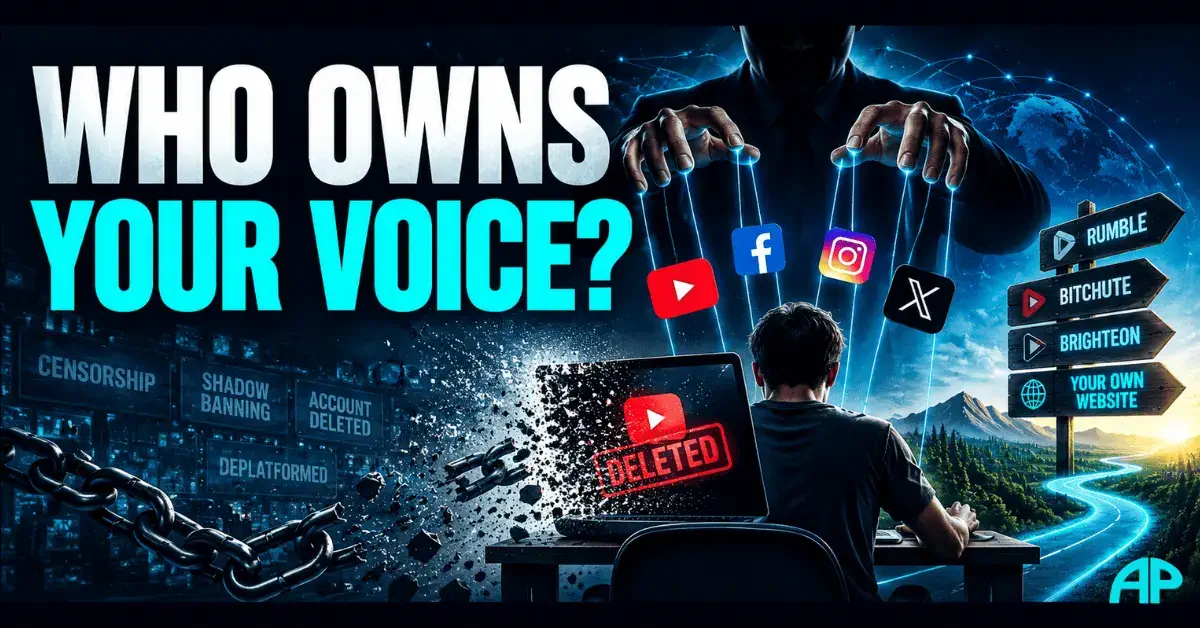
We keep fighting social media censorship while trusting the very platforms that can silence us overnight.
When Are We Going to Learn?
We keep fighting social media censorship while trusting the very platforms that can silence us overnight.
Sometimes I think we’re digging our own graves.
And the maddening part is that we know we’re doing it.
I had my YouTube channel permanently deleted after publishing a single video discussing COVID.
One video. One decision. Channel gone.
No meaningful opportunity to defend myself.
That experience taught me something I’ve never forgotten.
You can spend years building an audience, only to discover that somebody else holds the keys to everything you’ve created.
And yet, five or six years later, I look around and see people walking straight back into the same trap.
Including some of the very people who were deplatformed during COVID.
I have to ask myself.
When are we going to bloody learn?
Five Years Later, Same Old Trap
Think back to the early days of COVID.
Remember what happened to people who questioned the official narrative? Those who challenged government policies, disputed restrictions, questioned medical advice or expressed opinions that didn’t fit the accepted storyline?
YouTube channels disappeared. Facebook accounts were suspended. Instagram accounts were shut down.
Years of work wiped out overnight.
Some of these creators had millions of followers. Entire businesses depended on those audiences, with advertising revenue, sponsorships and other income supporting families and employees.
Then one morning, it was gone.
Just like that.
I was small fry compared with some of those enormous accounts. But that doesn’t make what happened to me right.
And I certainly haven’t forgotten it.
What amazes me is how many people have returned to the very platforms that removed them.
Back to YouTube, Facebook and Instagram.
Building audiences. Generating income. Putting their livelihoods in somebody else’s hands.
As though nothing happened.
As though it could never happen again.
What the hell are we doing?
I understand the attraction.
YouTube has an enormous audience. Facebook and Instagram offer exposure that smaller platforms struggle to match.
That’s where the traffic is, and potentially the money.
But at what cost?
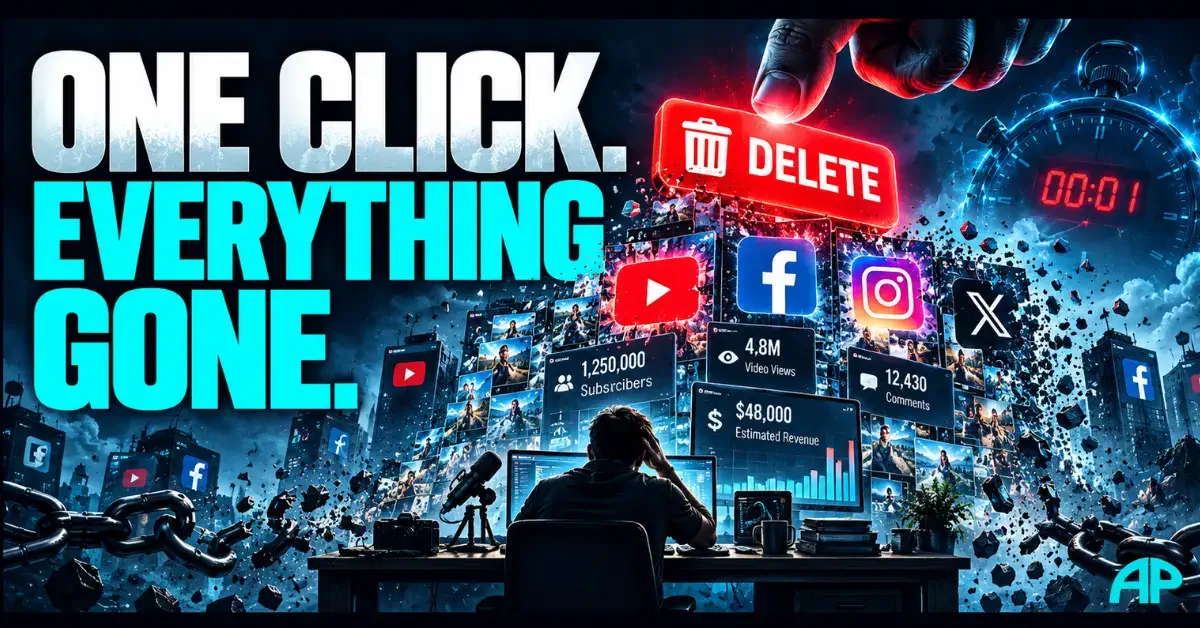
What good is having a million subscribers if a policy change, an automated moderation system or a decision made by somebody you’ve never met can wipe out your livelihood overnight?
Why would you willingly put yourself in that position again?
The answer is uncomfortable.
It’s convenient. Everybody is there. Building something independent takes more effort.
But convenience isn’t security.
Reach isn’t ownership. And followers aren’t necessarily an audience you control.
We’ve confused all three.
Social Media Censorship Never Went Away
Here’s something else that bothers me.
Social media censorship doesn’t always mean having your account deleted.
Sometimes it’s much harder to recognise.
A video gets removed. Another post is restricted. Perhaps a channel loses its monetisation.
Or your content simply stops reaching people.
You continue uploading and publishing, doing everything you’ve always done.
But suddenly, hardly anybody sees it.
Your audience stops growing, and your videos barely get watched.
People call it shadow banning.
Now, I’m not suggesting every poorly performing video is evidence of censorship.
Algorithms change. Audiences lose interest. Sometimes content simply doesn’t connect.
But when the systems deciding what people see are largely invisible, how can anyone confidently tell the difference?
That’s what concerns me.
A handful of corporations have enormous influence over what billions of people encounter online.
Their systems determine which content gets promoted, restricted or removed.
Meanwhile, creators are left trying to understand the rules of a game they don’t control.
When somebody else decides who gets seen, who gets heard and who gets paid, how independent are we really?
The Most Effective Censorship Is Self-Censorship
This is where things get particularly ridiculous.
We’ve reached a point where people carefully choose their words, not because they believe those words are wrong, but because they’re frightened of upsetting an algorithm.
Can I mention COVID?
What about discussing vaccines?
Should I avoid that particular word?
Will this headline get my video removed?
Perhaps I should change the title or soften what I’m saying?
Maybe it’s safer to avoid the subject altogether.
Before you know it, you’re doing the censoring yourself.
Nobody even needs to remove your video.
You’ve already watered down the message before anybody gets to hear it.
Think about how absurd that is.
We’re supposedly living in an age of unprecedented communication. Today, we can reach people on the other side of the planet in seconds.
Yet we’re increasingly worried about which words we’re allowed to use.
Of course, freedom of expression doesn’t mean freedom from criticism or accountability.
If we make claims, we should be prepared to support them. When we’re wrong, we should correct ourselves.
That’s perfectly reasonable.
But being afraid to express an honestly held opinion or ask a legitimate question because a platform might punish you?
That’s another matter entirely.
And it raises a question every independent creator should ask.
If we have to keep diluting our message to stay on a platform, aren’t we defeating the whole purpose of speaking out?
Is Rumble Really the Answer?
A lot of people have turned to Rumble.
It’s promoted itself as a free-speech alternative to YouTube, and I can understand the attraction.
But personally, I’m cautious.
Its my understanding that Peter Thiel has been a significant investor in Rumble.
He’s also a co-founder of Palantir, the controversial data analytics company involved in government, intelligence and defence work.
And I’ll be upfront.
I have serious concerns about Palantir, surveillance technology and the growing concentration of information in the hands of governments and powerful corporations.
That doesn’t automatically mean Thiel controls Rumble’s editorial decisions.
Nor does it mean Rumble operates like YouTube.
But I don’t believe we should stop asking questions simply because a company presents itself as the alternative.
Who owns it?
Where does its financing come from?
Who controls the infrastructure?
How are decisions about content made?
And what happens when commercial interests change?
Because here’s the thing.
Replacing one powerful gatekeeper with another isn’t necessarily freedom.
It might just be a different gatekeeper.
Surely the answer isn’t to find another corporation we can blindly trust.
Perhaps the real answer is to stop being so dependent on corporations in the first place.
Some People Are Building Their Own Alternatives
One person I have a great deal of respect for, particularly when it comes to building independent publishing infrastructure, is Mike Adams, also known as the Health Ranger.
He’s the man behind Natural News and the Brighteon network.
Now, I know he’s controversial.
Some people strongly disagree with his opinions and the material published through his networks.
That’s their prerogative.
But whether you agree with him or not, there’s something worth recognising about what he’s built.
Rather than relying entirely on YouTube and mainstream social media platforms, he’s developed his own publishing and video distribution ecosystem.
He’s invested in infrastructure, created alternatives and worked to establish an audience beyond the traditional social media giants.
And that deserves consideration.
You don’t have to agree with everything somebody says to respect their determination to build something they control.
Then there’s BitChute, another video platform that has positioned itself as an alternative to mainstream video hosting.
Neither platform is perfect. No platform is.
They all have policies, technical limitations, operating costs and potential points of failure.
But why aren’t more of us supporting these alternatives?
Why do we keep complaining about the power of mainstream platforms while continuing to give them most of our attention?
Every video we upload, every audience we build and every hour we spend on these platforms helps reinforce their importance.
And yes, I’m guilty of it too.
Most of us are.
That’s what makes this so frustrating.
We know the problem, talk about it endlessly, then go straight back to feeding it.
We’re Preaching Freedom While Living on Borrowed Land
This is the contradiction I can’t get past.
We have people spending hours every day exposing corruption, questioning authority, discussing government overreach and warning about the concentration of power.
And where are they doing it?
YouTube. Facebook. Instagram.
Platforms they don’t own, with rules that can change tomorrow.
Their content can be removed, their reach restricted or their accounts terminated.
Does anybody else see the problem?
We’re preaching independence while remaining completely dependent.
We talk about freedom while asking permission to speak.
At the same time, we’re warning people about centralised power while helping to strengthen some of the most powerful communication networks in history.
It’s an astonishing contradiction.
And the worst part?
We know better.
We’ve seen people lose everything they’ve built. Some of us have experienced it ourselves.
Yet we keep going back.
Why?
Convenience? The promise of a bigger audience? Perhaps starting somewhere else seems too difficult.
Whatever the reason, the fundamental problem remains.
We’re building our futures on borrowed land.
And the landlord can change the locks whenever the rules allow it.
What Happens When They Pull the Plug Again?
Imagine spending the next five years building a successful YouTube channel.
Hundreds of videos. Thousands of hours of work. A loyal audience. Perhaps a decent income.
Then one morning you wake up to discover your account has been terminated.
What do you do?
Where do you go?
How will you contact your subscribers?
What happens to your income?
And here’s the biggest question.
How do you tell your audience where you’ve gone when the only place they knew you existed has just removed you?
Think about that.
You could have a million subscribers and no reliable way of contacting them.
That’s not independence.
It’s dependency dressed up as success.
And it doesn’t matter whether your content is about politics, health, business, technology or gardening.
If your entire audience exists on somebody else’s platform, you’re vulnerable.
You don’t own the relationship.
You have access to it.
And that access can disappear.
Why Blogging Still Matters More Than Ever
This is one reason I believe blogging is more important today than it has been for years.
And I’m not talking about starting a blog someday.
I’ve already got one.
You’re reading it.
This website is my home base.
It’s where I publish my thoughts, develop ideas, share information and maintain a record of what I’ve written.
Most importantly, it’s somewhere I have far more control.
If YouTube removes one of my videos, I can still publish an article here.
Should Facebook suspend my account, readers can still visit my website.
Even if an algorithm stops showing my content, I can communicate with people who subscribe directly.
That’s a massive difference.
A Place Where Ideas Can Breathe
A blog also gives ideas room to breathe.
Social media encourages quick reactions, short videos, catchy headlines and endless scrolling.
Important subjects are often reduced to a few sentences before everybody moves on to the next distraction.
Blogging allows me to explain what I mean, provide context and link to sources.
There’s room to correct mistakes, develop ideas and build a permanent archive rather than a stream of disposable content.
Of course, owning a website doesn’t make you untouchable.
Hosting companies can suspend accounts. Domain names can be challenged. Servers can fail.
I’m not pretending otherwise.
But there’s a significant difference between relying on technical infrastructure and handing one company control over your content, audience, distribution and income.
With a properly managed website, independent backups and your own domain, you have options.
Changing hosting providers is possible. Your content can be preserved, and rebuilding becomes much easier.
If you’ve developed an email list, you can also maintain a direct connection with readers who want to hear from you.
A website isn’t absolute freedom. But it’s a hell of a lot better than having nowhere else to go.
And if you haven’t started a blog yet, perhaps it’s time you seriously considered it.
You don’t need to be a technical genius or an experienced writer. All you need is something worth saying and somewhere to say it.
I’ve put together a practical guide on blogging for beginners that walks you through getting started, building an audience and even turning your blog into a source of income.
The sooner you start building something of your own, the less you’ll have to depend on somebody else’s platform.
Your Email List May Be Worth More Than a Million Followers
Here’s something else people tend to overlook.
An email list.
It might sound old-fashioned compared with YouTube subscribers, Instagram followers and Facebook groups.
But think about it.
When somebody voluntarily gives you their email address because they want to hear from you, you’ve established a direct connection.
You can communicate without relying entirely on a social media recommendation system.
Moving between email service providers is possible, and you can maintain your subscriber records, subject to privacy laws and the permissions people have given you.
Most importantly, you can let people know where to find your work.
Compare that with a million YouTube subscribers.
Can you contact them directly?
Are their email addresses available to you?
Could you take those relationships with you if your channel disappeared?
Generally, no.
You might have an enormous following, but the platform still controls your access to it.
Three Things Every Creator Should Own
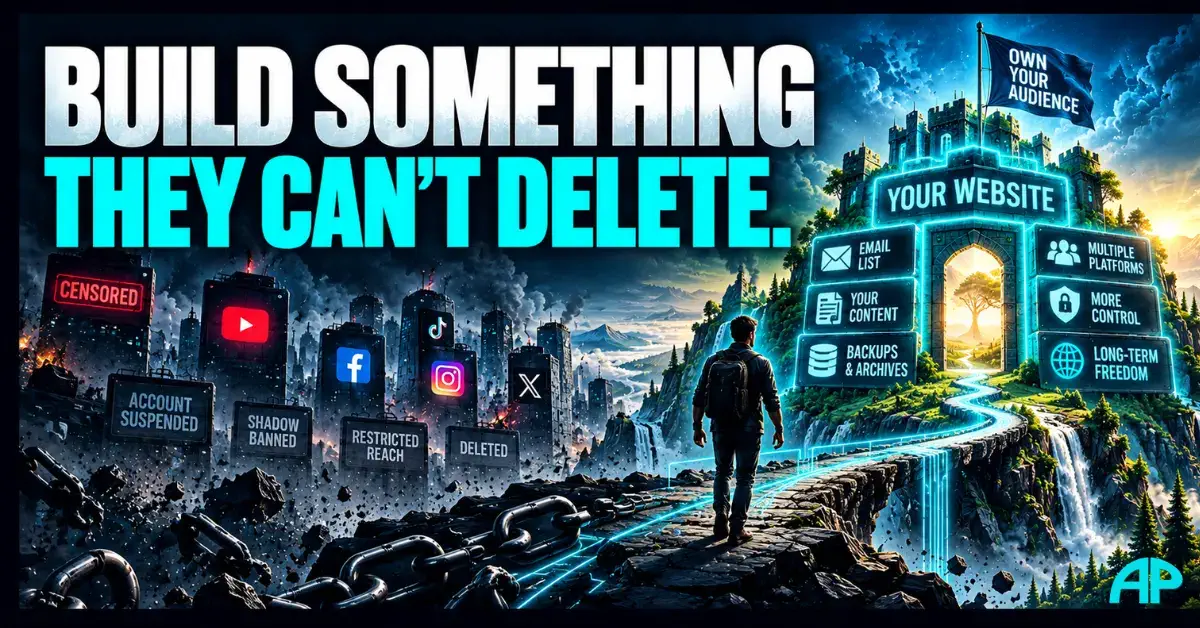
That’s why I believe every serious content creator should build three things:
- A website they control. A permanent home for their content, identity and archives.
- An independent email list. A direct relationship with people who choose to follow their work.
- Multiple distribution channels. So losing one account doesn’t mean losing everything.
It’s not complicated.
But it does require us to stop thinking that social media followers are the same as an independent audience.
They’re not.
So What Am I Going to Do Differently?
I’ve been thinking about launching another brand.
Outthinkers.
A platform built around questioning conventional thinking, challenging accepted narratives and encouraging people to think for themselves.
And if I go ahead with it, I want to approach things differently.
I’d like to give platforms such as BitChute and Brighteon serious attention from the beginning.
Not as an afterthought.
Certainly not as somewhere to dump videos after they’ve been uploaded to YouTube.
Instead, they would become genuine parts of the publishing strategy.
Will I still use YouTube?
Probably.
Facebook and Instagram?
Possibly.
Rumble?
Maybe.
I’m not suggesting we should abandon platforms that can put our ideas in front of millions of people.
That would be cutting off our noses to spite our faces.
But there’s an enormous difference between using a platform and depending on it.
And that’s the lesson I think we need to learn.
Use the Platforms. Don’t Depend on Them.
Use YouTube for exposure.
Let Facebook help you reach people.
Instagram might be useful too.
But make your own website the home base.
Develop an email list and keep independent copies of everything you publish.
Spread your content across multiple platforms while supporting alternatives that genuinely offer creators more control.
Above all, make sure that if one company decides it no longer wants you, your entire online existence doesn’t disappear with it.
Use the big platforms. Just don’t let them own your future.
We Can’t Fight Social Media Censorship While Feeding It
Here’s where I think we need to be a little harder on ourselves.
It’s easy to blame YouTube, criticise Facebook or complain about algorithms, censorship policies and corporate control.
And sometimes those criticisms are entirely justified.
But what about our own decisions?
Why do we keep putting all our eggs in the same basket?
What makes us spend years building audiences we can’t contact independently?
How did we allow platforms to gain so much power over our businesses and livelihoods?
And why do we talk about independence without taking the practical steps to achieve it?
At some point, we have to accept responsibility.
Not for the decisions these companies make.
But for how vulnerable we allow ourselves to become.
Independence Takes Effort
Because we have choices.
They might not be easy choices.
Building a website takes effort. Growing an email list takes time. Publishing across multiple platforms creates more work.
Supporting smaller alternatives may also mean accepting less immediate exposure.
But surely that’s better than spending years building something that can disappear with one account termination.
Freedom without independence is a fragile thing.
And independence doesn’t happen simply because we talk about it.
We have to build it.
When Are We Going to Learn?
I don’t have all the answers.
And I’m certainly not pretending I’m immune to the attraction of mainstream social media.
I’ve fallen into the same trap myself.
But I do know this.
We can’t keep complaining about social media censorship while willingly making ourselves dependent on the very platforms we’re criticising.
Nor can we keep preaching independence while handing over control of our audiences.
And we certainly can’t keep acting surprised when companies exercise the power we’ve allowed them to accumulate.
At some point, we have to stop confusing convenience with freedom.
Followers aren’t ownership. A social media account isn’t a permanent home.
And supporting alternatives has to mean more than merely talking about them.
Maybe that means growing more slowly.
Perhaps it means sacrificing some immediate exposure or putting in more effort to build something that genuinely belongs to us.
So be it.
Because what’s the alternative?
Spend another five years building an audience, only to wake up one morning and find it’s gone?
Start again?
Complain again?
Move to another platform and repeat the same mistake?
How many times do we have to get burned before we stop putting our hands back in the fire?
I’m not saying we should abandon YouTube, Facebook or Instagram.
I’m saying we should stop treating them as though they’re indispensable.
They’re tools.
Powerful tools. Useful tools.
But still tools.
They should help us reach people, not become the only way people can reach us.
And if we’re serious about freedom of expression, independent thinking and taking back control, surely it’s time we started putting those principles into practice.
Otherwise, we’ll keep repeating the same mistakes.
Over and over.
Until the next mass banning.
The next crackdown.
The next wave of social media censorship.
And then we’ll all act surprised.
Again.
So I’ll ask the question one more time.
When are we going to fucking learn?


