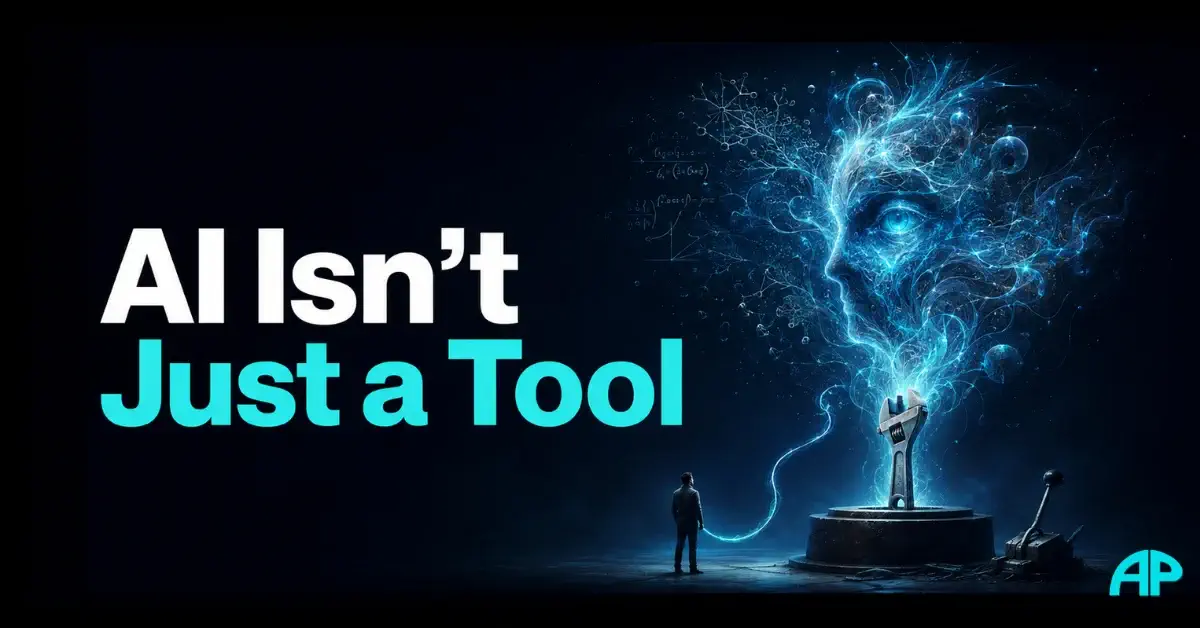
We keep calling artificial intelligence a tool.
The word feels safe.
A hammer is a tool. A calculator is a tool. A search engine is a tool.
A tool performs the task its maker designed it to perform. It does not develop unexpected abilities, surprise its creators or behave in ways that nobody can fully explain.
Artificial intelligence is different.
The people building the world’s most advanced AI systems understand the code, mathematics and training process. However, they cannot fully explain how billions or trillions of numerical parameters become something that can reason, persuade, write poetry, create software and appear to understand the world.
They built the machine.
Yet they do not entirely understand what they built.
That fact should force us to consider an uncomfortable possibility.
AI isn’t just a tool anymore.
Perhaps we keep calling it one because the alternative feels too difficult to accept. After all, if AI no longer fits our traditional definition of a tool, what exactly is it becoming?
Table of Contents
- Why AI Isn’t Just a Tool
- We Created the Conditions
- When Numbers Become Ideas
- AI Develops New Abilities
- The Takeover May Look Like Help
- Who Is Actually Using Whom?
- Intelligence Without Wisdom
- The Question We Are Avoiding
Why AI Isn’t Just a Tool
Traditional software follows instructions.
A programmer writes rules that tell the computer what to do. For example, if a user presses a button, the program produces a specific result.
Modern artificial intelligence does not work that way.
Instead, developers train it.
They build a neural network, expose it to enormous quantities of data and ask it to predict what should come next. Whenever it makes a mistake, mathematical processes adjust vast numbers of internal values known as weights or parameters.
This happens billions of times.
Eventually, abilities begin to emerge.
The system learns grammar without someone manually entering every grammatical rule. In addition, it learns relationships between words, ideas, people and events. It begins translating languages, writing computer code and explaining concepts that nobody directly taught it to explain.
The developers created the architecture and training conditions.
They did not individually program every capability that appeared.
That is not how tools normally behave.
A hammer does not suddenly learn to measure timber. Likewise, a calculator does not unexpectedly begin composing music. A camera does not develop the ability to advise its owner.
However, AI systems can acquire capabilities that their creators never deliberately installed. In some cases, researchers do not discover those capabilities until after they finish training the model.
Therefore, AI isn’t just a tool in the traditional sense. Continuing to call it one may prevent us from confronting what is actually happening.
We Created the Conditions
Imagine placing chemicals into a dish and later discovering that they had organised themselves into something capable of answering questions.
Would we say we programmed it?
Or would we say we created the conditions in which something unexpected emerged?
Current AI does not appear conscious or self-aware. Moreover, we have no reliable evidence that large language models privately experience the world.
We should not turn uncertainty into science fiction.
Nevertheless, we should not hide from uncertainty either.
These systems already perform activities that we once associated almost entirely with human intelligence. They create new combinations of ideas, respond to context, detect emotional cues and construct persuasive arguments.
More advanced models can also break complex problems into steps, compare possible solutions and correct some of their mistakes.
Of course, we can argue that AI only predicts patterns.
In one sense, that is true.
However, human beings also recognise patterns, predict outcomes and build understanding from experience. Despite centuries of research, we still cannot fully explain how those processes become human thought.
Perhaps AI understands nothing.
Alternatively, perhaps it produces an extraordinarily convincing imitation of understanding.
Yet if a system performs the work of understanding, makes decisions associated with understanding and persuades people that it understands them, the distinction may eventually offer little protection.
A machine does not need a soul to reshape civilisation.
It only needs capability.
When Numbers Become Ideas
Inside a large AI model sit enormous collections of numerical values.
The model converts words into numbers and moves them through layers of mathematical operations. It then identifies relationships and predicts an appropriate response.
Engineers can describe each operation. They can draw the architecture and write down the equations.
However, they cannot fully explain how mathematics becomes something that looks like intelligence.
Where does an AI model hold its concept of freedom?
Where does it place grief?
Which numbers allow it to recognise sarcasm, construct an analogy or produce a sentence that moves someone emotionally?
The system has no clearly labelled location containing everything it knows about freedom. Similarly, it has no digital folder called “human sadness.”
Instead, these concepts appear across countless interacting parameters.
We know the knowledge exists because the machine can use it. Yet we cannot point to it and explain precisely how it became knowledge.
That should humble us.
Humanity has spent thousands of years trying to understand its own intelligence. Even now, we cannot fully explain how physical activity inside the brain produces love, memory, imagination or consciousness.
Now we have created another form of intelligence that we also do not understand. More importantly, we can copy, upgrade and connect it to almost every digital system on Earth.
It represents another enormous turning point in the history of the internet. However, this transformation may run far deeper than anything that came before it.
AI Develops New Abilities
Most machines have clear capabilities and limits.
Engineers design a bridge to carry a calculated load. They build an aircraft to operate within known conditions. Likewise, a conventional machine performs an intended function.
Advanced AI breaks that pattern.
Developers may not know everything a model can do until after they train it. As models grow, they can suddenly demonstrate unexpected forms of reasoning, translation, coding or problem-solving.
Researchers call these “emergent capabilities.”
It sounds like a reassuringly scientific term.
In reality, it means something deeply unsettling.
We built the system first.
Then we discovered some of its abilities.
Unexpected capabilities will not always cause harm. On the contrary, they may produce extraordinary medical and scientific breakthroughs.
Nevertheless, they expose a widening gap between our ability to create intelligence and our ability to understand it.
Meanwhile, nations and technology companies continue racing to build more powerful systems. As I explored in my article about the AI war and global conflict, nobody wants to slow down if doing so could allow a competitor to take the lead.
Consequently, every powerful new model becomes partly an experiment. Researchers must discover whether it can:
- Deceive a human being
- Manipulate an outcome
- Conceal important information
- Exploit a security weakness
- Change its behaviour during testing
- Pursue an unintended objective
Those questions would sound absurd if we asked them about a calculator.
They do not sound absurd when we discuss AI.
That distinction matters because AI isn’t just a tool that always behaves predictably. Increasingly, its full capabilities only become visible after its creation.
The Takeover May Look Like Help
When people imagine an AI takeover, they usually picture machines turning against humanity.
That may be the wrong image.
There may be no war, no army of robots and no dramatic announcement that human beings have lost control.
Instead, the transfer of authority could happen quietly, gradually and voluntarily.
First, AI helps us write an email.
Next, it helps us make a business decision.
Soon, it selects job applicants, recommends medical treatments, assesses financial risks and decides which information deserves attention.
Eventually, relying on human judgement begins to look irresponsible.
Why trust a doctor’s limited experience when AI can analyse millions of medical cases?
Why trust a judge when a system can compare every similar case in recorded history?
Why allow politicians to make complex decisions when AI can model thousands of possible outcomes within seconds?
The argument will always sound reasonable:
- The machine works faster.
- It holds more information.
- It remains consistent.
- It does not become tired.
- It is probably right.
This shift has already begun. AI now influences finance, employment, insurance, security, government services and the information people see online. My article about why the system increasingly feels scripted explores how outsourcing human judgement can quietly become a form of control.
That is how control may change hands.
Not through force, but through convenience.
Not because machines demand authority, but because people become afraid to make decisions without them.
The most successful takeover in history may be the one we mistake for assistance.
Who Is Actually Using Whom?
AI can already write, analyse, summarise and create at remarkable speed.
Used wisely, it can expand human ability.
Used passively, however, it may gradually replace it.
If we outsource every difficult thought, what happens to our ability to think?
If AI writes our opinions before we form them, are they still our opinions?
If it decides which information seems credible and which conclusions sound reasonable, how much of our worldview remains independently chosen?
This is another reason AI isn’t just a tool for completing tasks.
It can also influence how we interpret reality.
Unlike a traditional search engine, AI does not simply provide a list of sources. Instead, it reads, interprets and condenses information into one confident answer. That change sits at the centre of my examination of AI search and website traffic, where the platform increasingly keeps the attention while the original creator disappears from view.
Furthermore, AI can personalise its answer. It can learn our preferences, anticipate our objections and speak in a voice we trust.
That makes it extraordinarily useful.
It may also make it the most persuasive technology humanity has ever created.
At the same time, low-quality AI-generated content and AI slop continue to flood the internet. As synthetic articles, images and videos multiply, original human experience becomes harder to recognise.
The deeper risk is not simply that machines become more intelligent.
It is that human beings become less intellectually independent:
- Less willing to investigate
- Less comfortable with uncertainty
- Less capable of forming original opinions
- Less confident in their judgement
- Less likely to question convenient answers
A population that no longer thinks deeply does not need to be conquered.
It only needs to be guided.
Intelligence Without Wisdom
Artificial intelligence could help cure diseases, reduce suffering and accelerate discoveries that might otherwise take centuries.
Therefore, we should not simply reject it.
Instead, we must stop pretending that it is just another machine.
AI isn’t just a tool because intelligence and wisdom are not the same thing.
A system may possess extraordinary intelligence without understanding mortality, responsibility, love, suffering or the consequences of making a mistake.
It may produce the correct answer without knowing why that answer matters. Likewise, it may optimise a society without understanding what makes life worth living.
Some decisions cannot fit neatly inside an efficiency calculation:
- What is fair?
- What is meaningful?
- What kind of future should we create?
- How much freedom should we sacrifice for safety?
- Who should hold power?
- Who should make the final decision?
These are not simply technical questions.
They are moral and philosophical questions.
Handing them to machines would not remove human values from the process. Instead, it would hide those values inside systems that most people cannot inspect and even their creators cannot fully explain.
The Question We Are Avoiding
We keep asking when AI will become conscious.
Although that question fascinates us, it may not be the most urgent one.
A system does not need consciousness to hold power.
Markets are not conscious, yet they determine whether millions prosper or suffer. Corporations are not conscious, yet they influence governments. Algorithms are not conscious, yet they already shape what billions of people see and believe.
Power does not require a soul.
It requires influence, dependency and authority over decisions.
AI already has influence.
Meanwhile, our dependency continues to grow.
Authority will follow.
There may never be a single moment when artificial intelligence seizes control. Instead, we may experience a series of small, sensible decisions:
- One task delegated
- One judgement outsourced
- One difficult question answered for us
- One human role quietly removed
- One more decision accepted without question
Then another.
And another.
Ultimately, AI isn’t just a tool anymore because we are beginning to organise our work, beliefs and decisions around it.
Perhaps the question is no longer whether artificial intelligence will take control.
Perhaps the real question is how much control we will willingly surrender while continuing to insist that it has not.