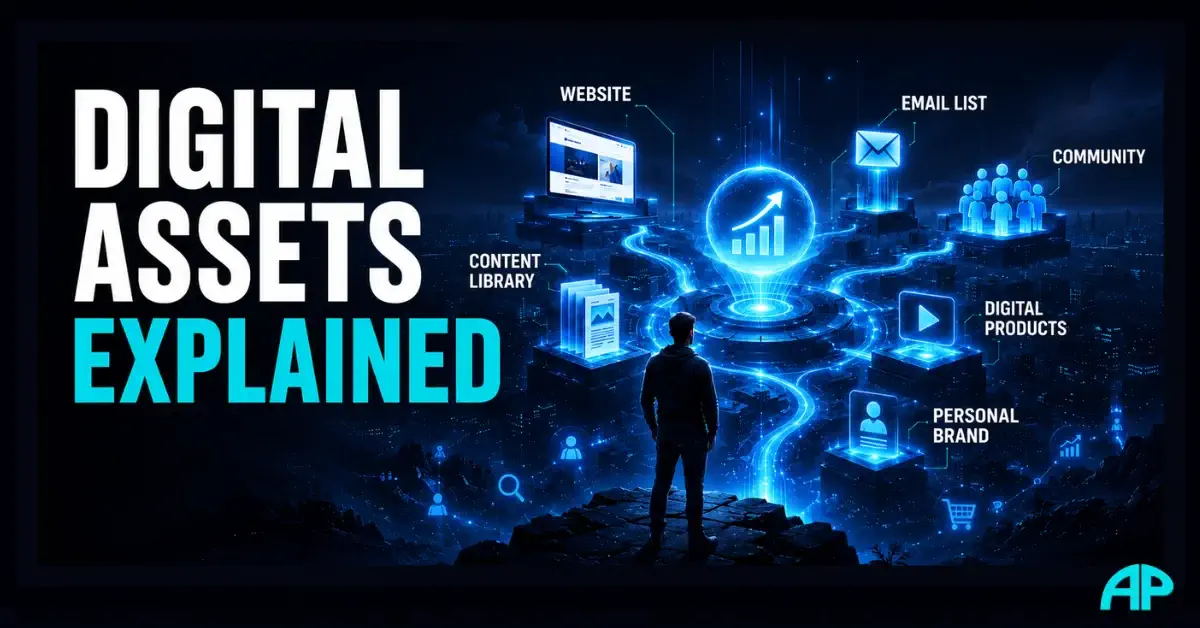
Learn how websites, content, email lists, and communities can become valuable online assets.
Table of Contents
- Digital Assets Explained
- What Are Digital Assets?
- Why Digital Assets Matter
- Your Website as an Asset
- Content as an Asset
- Your Email List as an Asset
- Community as an Asset
- Your Brand as an Asset
- Assets Grow Over Time
- Content vs Assets
- How to Start Building
- Build Assets Early
Digital Assets Explained for Beginners
Most people think of assets as physical things.
A house.
A car.
Land.
Equipment.
Stock.
A business.
Money in the bank.
Those things are easy to understand because you can see them, touch them, value them, and sell them.
However, the online world has also created another type of asset.
Digital assets.
And for many people, these can become some of the most valuable assets they ever build.
That does not mean every blog post, website, email list, community, or social media profile is automatically valuable.
Far from it.
A digital asset only becomes valuable when it does something useful.
It might attract attention.
It might build trust.
It might collect leads.
It might educate people.
It might create digital leverage.
It might help sell a product or service.
It might give you a platform you control.
That is why understanding digital assets matters, especially if you want your online work to keep creating value over time.
Because if you are trying to build a personal brand, online business, content platform, community, or long-term income stream, you are not just “posting content.”
You are building something.
And if you build it well, that something can keep working for you long after you first created it.
So, let’s keep this simple and start with the basics.
This is digital assets explained for beginners in plain English, without the hype, jargon, or overcomplication.
What Are Digital Assets?
Put simply, a digital asset is something you create or own online that can provide value over time.
It may help people find you.
It may help people trust you.
It may help you communicate with an audience.
It may help you generate leads, sales, influence, or opportunities.
In simple terms, a digital asset is an online property, resource, or piece of content that has usefulness beyond the moment you create it.
For example, a well-written blog post can keep attracting readers for years.
A website can become your digital home base.
An email list can let you speak directly to people who want to hear from you.
A course can be sold again and again.
Likewise, a community can become more valuable as more of the right people join.
A content library can also build authority over time.
At its simplest, digital assets explained for beginners means understanding that some things you build online can keep creating value after the original work is done.
That is the key point.
A digital asset is not valuable just because it exists.
Instead, it becomes valuable because it helps create trust, attention, connection, sales, or leverage.
Why Digital Assets Matter
One of the biggest mistakes many people make online is building everything on rented ground.
They post on social media.
They chase likes.
They try to grow followers.
They rely on platforms they do not own.
To be clear, social media can be useful.
In fact, it can be very useful.
However, it should not be the whole strategy.
Because you do not control the platform.
You do not control the algorithm.
You do not control the rules.
You do not control whether your account gets restricted, buried, hacked, or ignored.
This is why digital assets matter so much.
And when we talk about digital assets explained for beginners, this is the part that matters most: control, trust, and long-term value.
A website, blog, email list, content library, and community can create a stronger foundation.
They help you build long-term value instead of chasing short-term attention.
Most importantly, they help people find you, understand you, and trust you before they ever buy from you.
That matters because trust is becoming harder to earn.
The internet is noisy.
AI has made content easier to produce.
Everyone is publishing.
Everyone is selling.
Everyone is trying to be seen.
Therefore, the people who build useful digital assets early will have an advantage.
They will not just have content.
They will have proof.
They will have a body of work.
They will have a platform.
And over time, they will have something that compounds.
Your Website as a Digital Asset
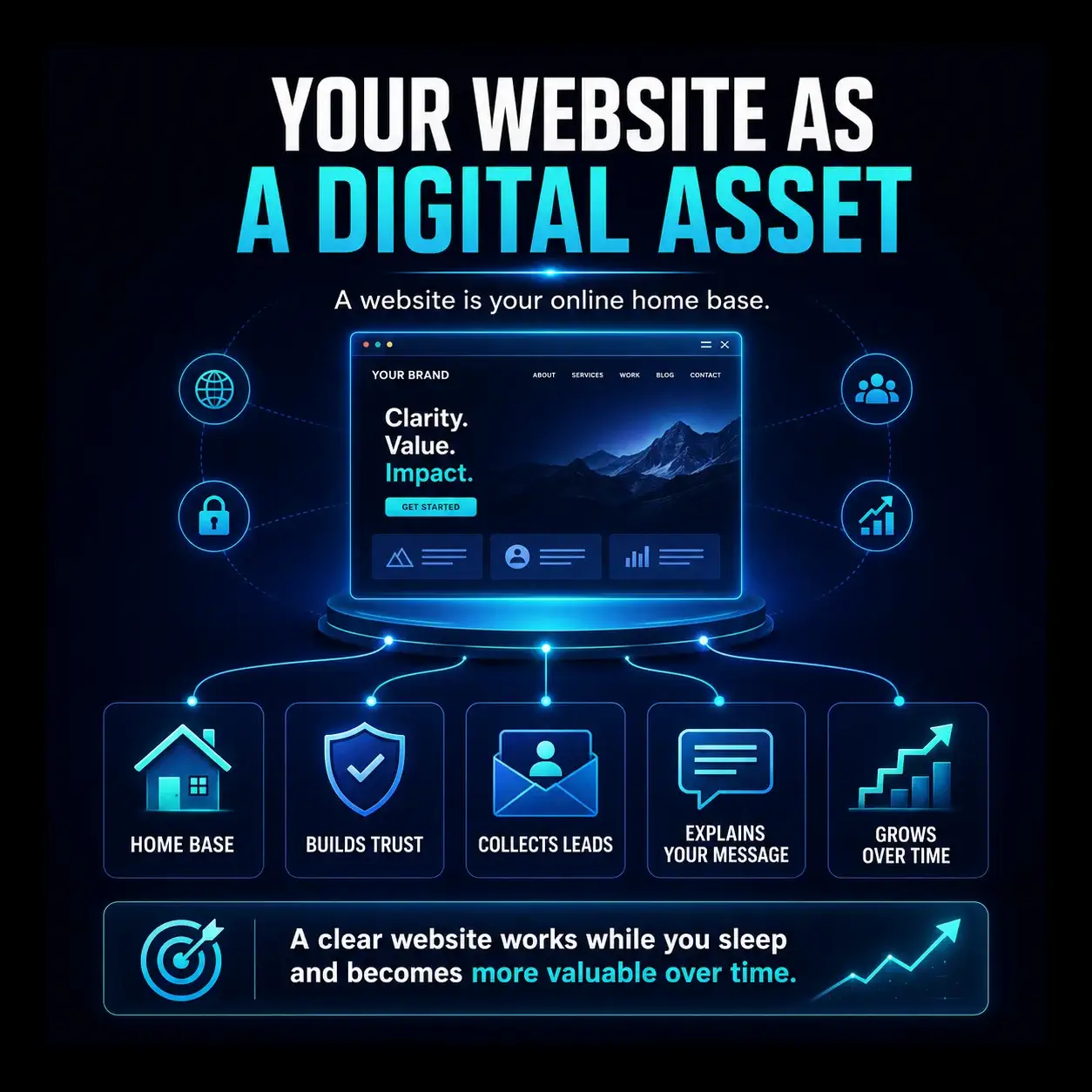
For starters, your website is one of the most important digital assets you can build.
In any guide on digital assets explained for beginners, your website should come near the top because it gives your brand a home base you control.
It is where people can find your best ideas, your offers, your story, your contact details, and your content.
Unlike social media, however, your website is not just a feed.
It is a structure.
It can be organised.
It can be searched.
It can be improved.
It can rank in Google.
It can collect leads.
It can explain who you are and what you do.
It can become a serious trust-building tool.
A good website does not need to be complicated.
However, it does need to be clear.
People should quickly understand:
Who are you?
What do you help with?
Who do you help?
Why should they trust you?
What should they do next?
When your website answers those questions well, it becomes more than a digital brochure.
Instead, it becomes a business asset.
It works while you sleep.
It introduces people to your thinking.
It supports your personal brand.
It gives your content a permanent home.
And over time, it can become one of the most valuable online assets you own.
Content as a Digital Asset
Unfortunately, content is often treated like something disposable.
People publish a post, get a few views, and move on.
However, good content can be much more than that.
A helpful blog post can keep working for years.
A useful guide can answer the same question again and again.
A strong article can build trust with people you have never met.
A clear explanation can turn a stranger into a subscriber.
A body of content can position you as someone worth listening to.
That is what makes content a digital asset, especially when it keeps helping people long after you publish it.
This is a key part of digital assets explained for beginners because many people do not realise one useful article can keep working long after it is published.
However, not all content does this.
Random content rarely compounds.
Shallow content rarely builds trust.
Content created only for attention often fades quickly.
Useful content lasts longer because it solves real problems.
It helps people understand something.
It gives them clarity.
It helps them make a better decision.
It makes them feel less overwhelmed.
That is why a content library is so powerful.
Each useful piece becomes another doorway into your world.
For example, one blog post may bring someone in through Google.
Another may help them understand your philosophy.
Another may answer an objection.
Another may explain your offer.
Another may build confidence.
Together, these pieces create digital leverage.
This is one reason I believe you should build your brand before you need it, because the content, trust, and audience you create today can become valuable digital assets tomorrow.
Your Email List as a Digital Asset
Next, your email list is one of the most underrated digital assets online.
When thinking about digital assets explained for beginners, your email list matters because it gives you direct communication with people who have already shown interest.
Of course, social media gets more attention.
However, email often creates more control.
When someone joins your email list, they are giving you permission to contact them directly.
That is powerful.
You are not waiting for an algorithm to show your post.
You are not hoping someone happens to see your update.
Instead, you have a direct line of communication with people who have chosen to hear from you.
Of course, that does not mean you should abuse it.
An email list only remains valuable if you respect the people on it.
If every email is a pitch, trust will fall.
However, if your emails are useful, honest, and relevant, trust can grow.
Your email list can help you:
Share new content.
Build a relationship.
Launch offers.
Invite people into a community.
Educate your audience.
Stay visible.
Create repeat touchpoints over time.
That last point matters because trust usually needs repeated contact.
People often need to hear from you more than once before they trust you.
Email gives you that opportunity.
It turns a one-time visitor into an ongoing relationship.
That is why an email list can become a serious business asset.
An Online Community as a Digital Asset
In addition, a community can become a powerful digital asset.
However, it must be built properly.
A real community is not just a group of people sitting in a Facebook group, Telegram channel, or private platform.
A real community has energy.
It has purpose.
It has shared values.
It gives people a reason to return.
It helps people feel part of something.
Over time, that can become very valuable.
Because when people join a community, they are not just consuming information.
They are connecting.
They are asking questions.
They are sharing progress.
They are learning from each other.
They are becoming more invested in the brand behind the community.
For a personal brand, this can be powerful.
A community can deepen trust.
It can create loyalty.
It can reveal what your audience really needs.
It can also become a place where ideas, offers, feedback, and opportunities naturally develop.
However, community takes care.
It cannot just be thrown together.
It needs leadership.
It needs clear boundaries.
It needs a reason to exist.
It needs a culture.
Without those things, however, it becomes noise.
With them, it can become one of the strongest digital assets you build.
Your Personal Brand as a Digital Asset
Finally, your personal brand can also become an asset.
In fact, it may become the asset that makes all the others more valuable.
That is because people do not only trust websites.
They trust people.
They want to know who is behind the content.
They want to know whether your message is real.
They want to know whether your values line up with your work.
They want to know whether you are consistent.
A personal brand helps connect all your digital assets together.
Your website gives you a home.
Your content gives you proof.
Your email list gives you connection.
Your community gives you depth.
But your personal brand gives all of it a human centre.
It gives people a reason to care.
This is why reputation matters so much.
A strong personal brand can make your content more trusted, your offers more believable, and your message easier to remember.
On the other hand, a weak or confusing personal brand can make even good content feel disconnected.
That is why personal branding and digital assets work so well together.
In other words, one supports the other.
Digital Assets Grow Through Consistency
However, digital assets do not usually become valuable overnight.
They grow through consistency.
One blog post is useful.
A full content library is stronger.
One email is a touchpoint.
A thoughtful email sequence builds more trust.
One website page can explain an idea.
A well-structured website can guide people through your whole message.
One community conversation is good.
A healthy community culture becomes more valuable over time.
This is where many beginners often get frustrated.
They create something once and expect immediate results.
But digital assets often compound slowly.
At first, it may feel like nothing is happening.
However, over time, the pieces begin to connect.
Your website gets clearer.
Your articles start ranking.
Your email list grows.
Your audience begins to recognise your message.
Your reputation strengthens.
Your brand becomes easier to understand.
That is the power of digital assets.
They reward patience.
They reward usefulness.
They reward consistency.
The Difference Between Content and Assets
This is important because not everything you publish becomes an asset.
Some content disappears quickly.
Some content gets attention but builds no trust.
Some content is too shallow to matter.
Some content is disconnected from your bigger message.
So, what actually turns content into an asset?
Purpose.
A useful digital asset usually has a job.
It might answer a common question.
It might explain a key idea.
It might attract the right audience.
It might support a product or service.
It might build trust before someone joins your list.
It might help someone take the next step.
When content has a clear purpose, it has a better chance of becoming valuable.
That is why your digital assets should connect to a bigger strategy.
Your blog posts should support your brand.
Your email list should support your relationship with your audience.
Your community should support a clear mission.
Your website should support trust and action.
When everything works together, your online presence becomes stronger and much easier to trust.
How to Start Building Digital Assets
You do not need to build everything at once.
In fact, you probably should not.
Instead, start with the basics.
First, build a simple website or improve the one you already have.
Then create useful content around the problems your audience cares about.
Next, start building an email list.
After that, consider whether a community makes sense.
You can also create downloadable guides, checklists, courses, videos, templates, or resource pages.
However, do not get distracted by the format.
After all, the format is not the point.
The value is the point.
Ask yourself:
Does this help the right person?
Does this build trust?
Does this support my message?
Can this keep working over time?
Does this strengthen my brand?
If the answer is yes, then you may be creating a digital asset.
That is digital assets explained for beginners in the simplest way.
Build useful things online that keep creating value after you create them.
Build Assets Before You Need Them
The best time to build digital assets is before you urgently need results.
Before you need traffic.
Before you need leads.
Before you need clients.
Before you need income.
Because when you build early, you give your assets time to work before you urgently need results.
You give your content time to rank.
You give your audience time to grow.
You give your email list time to develop.
You give your community time to form.
Most importantly, you give trust time to build.
Ultimately, that is the real advantage.
Digital assets are not magic.
They will not save a weak message overnight.
They will not fix a brand with no trust.
They will not replace doing the work.
However, if you build them with patience, usefulness, and consistency, they can create real leverage.
They can help people find you.
They can help people understand you.
They can help people trust you.
And eventually, they can help create opportunities that would not have existed otherwise.
So, if you are just getting started, do not overcomplicate it.
The simplest version of digital assets explained for beginners is this: build useful things online that can keep helping people, building trust, and creating opportunities over time.
So, start with one useful asset.
Then, build another.
Then keep going.
Eventually, those pieces can become something much bigger than content.
They can become a platform.
They can become a reputation.
They can become a business foundation.
They can become part of your future.
That is the real value of digital assets.