What actually works when you want links that build trust and rankings
Table of Contents
- Quality Backlinks Still Matter
- Why Backlink Strategies Fail
- What Are Quality Backlinks
- How to Get Quality Backlinks
- Guest Posting That Still Works
- Podcasts and Earned Links
- Create Content Worth Linking
- Relationships Still Matter
- Brand Helps You Earn Links
- Backlink Tactics to Avoid
- Smarter SEO Link Building
- Build Something Worth Linking
- FAQs About Quality Backlinks
Everybody wants backlinks.
Very few people want to earn them the right way.
That is where the trouble begins.
The moment people hear that backlinks can help rankings, they start chasing them like hungry dogs after scraps. They buy cheap packages. They swap links with random websites. They submit their site to weak directories. They send lifeless guest post pitches to anybody with a contact form and call it strategy.
Most of the time, it is not strategy at all.
It is noise.
A backlink is not magic.
It is not a cheat code.
And it is definitely not something you should judge by volume alone.
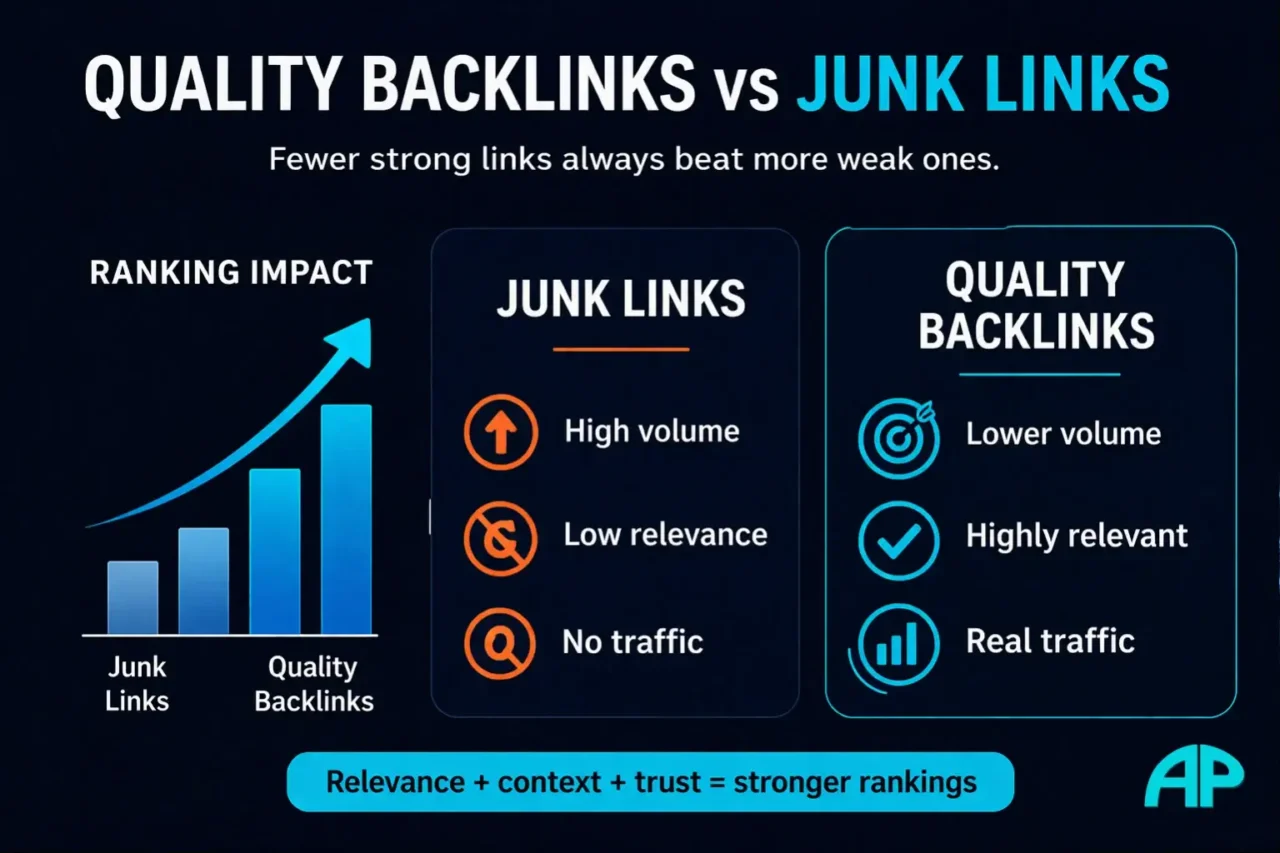
One strong link from a trusted and relevant website can do more for your site than a pile of weak links from websites nobody reads, nobody trusts, and nobody remembers. That is the truth too many people miss.
Yes, quality backlinks still matter, and quality backlinks are still one of the clearest trust signals a website can earn.
But junk never did.
If you want to build a stronger website, earn more trust, and support your rankings over time, you need to stop chasing rubbish and start thinking more clearly about what makes a link worth having in the first place.
Why Quality Backlinks Still Matter
A backlink is simply a link from another website pointing to yours.
Simple enough.
But what sits behind that link is what really matters.
When a relevant and trustworthy website links to your content, it sends a signal. It suggests your page is useful, relevant, and worth mentioning. That is why backlinks have mattered for years and still matter now.
But not all backlinks carry the same weight.
A link from a respected site in your space is not the same as a link buried deep inside a weak article on a website built purely to sell placements. One can support trust. The other can be little more than background clutter.
This is where people get themselves into trouble.
They hear that backlinks matter, then assume more must be better.
Not true.
Relevance matters.
Context matters.
Trust matters.
The reason for the link matters.
If the link is there because your content genuinely helped the writer make a point, support an argument, or expand on an idea, that is one thing. If it is there because somebody squeezed it into a low quality article for SEO purposes, that is something else entirely.
That is why quality backlinks still matter. They can support authority, trust, and discoverability when they come from the right places for the right reasons.
Why Most Backlink Strategies Fail
Most link building fails because it starts with the wrong question.
People ask, “How can I get more links?”
That sounds reasonable on the surface, but it is the wrong focus.
A better question is this:
Why would anyone want to link to this page in the first place?
That is where the real shift happens.
If your page is weak, bland, generic, or no better than the other ten posts already out there, strong links become hard to earn. Even if you manage to pick up a few, they are often forced, expensive, or low value.
That is when people start doing silly things.
They buy bulk links.
They chase every directory they can find.
They swap links with irrelevant websites.
They obsess over metrics and forget to ask whether the linking site has any real audience or value.
They focus on the link and ignore the asset.
That is not strategy.
That is impatience.
The strongest backlink strategies usually begin long before outreach. They begin with stronger content, clearer positioning, and pages that actually deserve attention. If you want better results, you need to spend more time creating blog pages people genuinely want to reference and less time chasing weak placements that add nothing to your brand.
That is the part too many people skip.
What Quality Backlinks Actually Look Like
Quality backlinks are worth having when they make sense for real people first.
That means the site linking to you is relevant.
That means the page around the link is useful.
That means the link fits naturally.
That means the site has standards.
That means you would still be pleased to get the mention even if search engines did not exist.
That last point matters more than most people realise.
If you would be embarrassed to show somebody the site linking to you, the link probably is not worth much.
A valuable backlink usually has a few clear traits.
It comes from a site related to your topic.
It appears inside real content, not filler.
It sits in a natural context.
It can send referral traffic, not just theoretical SEO value.
It supports trust rather than undermining it.
For a site like AndrewPlimmer.com, a useful link might come from a business blog, a branding website, a content marketing platform, an online business publication, or a podcast page connected to entrepreneurship, affiliate marketing, AI, or personal branding.
That makes sense.
A link from some bloated website publishing everything from crypto hype to miracle skin cream does not.
The point is not to collect links.
The point is to collect the right ones.
How to Get Quality Backlinks The Right Way
The answer is not glamorous, but it works.
Create better content.
Build real relationships.
Give people a reason to mention you.
That is the foundation.
If you want quality backlinks, you need a better reason to be mentioned than simply wanting a boost in rankings.
Guest Posting for Quality Backlinks
Guest posting can still work very well when you do it properly. The mistake people make is treating it like a factory line. They pitch weak ideas, write generic filler, and aim for any website that will publish them. That approach produces clutter, not credibility.
A better move is to identify a smaller number of genuinely relevant websites and pitch an article that actually fits their audience. Write something with substance. Make it useful. Make it strong enough that the link feels earned instead of inserted.
Podcasts and Earned Backlinks
Podcast appearances are another smart play, especially for a personal brand. One good interview can earn you a backlink from the episode page, exposure to a fresh audience, and a stronger digital footprint overall. That is a far better outcome than paying for some forgettable mention on a weak blog.
Create Content That Earns Backlinks
Another strong move is to build pages people actually want to cite. Detailed guides, practical frameworks, opinion pieces with a sharp angle, myth busting articles, case studies, and resource pages all tend to attract stronger attention than generic filler content. That is one reason so many people asking how to build content people actually want to link to get better results once they stop writing for search engines alone and start writing for real humans with real questions.
Relationships Still Matter in Link Building
You can also earn backlinks through relationships. Clients, collaborators, communities, suppliers, podcast hosts, and business contacts can all become natural sources of mentions over time. The internet may look technical on the surface, but some of the best opportunities still come down to trust and relevance.
Why Brand Helps You Earn Better Backlinks
Backlinks are not just an SEO issue.
They are also a branding issue.
Think about who gets mentioned more often.
The person with a clear message, a strong point of view, and memorable content?
Or the person publishing the same dull, keyword driven material as everybody else?
A Strong Brand Makes Quality Backlinks Easier
Brand helps links happen.
A clear brand makes your content more recognisable.
It makes your outreach feel less cold.
It gives people a reason to remember you.
It helps others understand what you stand for and why your work matters.
This is one of the biggest advantages of a personal brand site. You are not forced to sound like a bland corporate content machine. You can bring voice, experience, and perspective into the content. That is often what makes your website easier to remember and trust in the first place, and it is a big reason personal brands can attract more meaningful mentions over time.
In many cases, the best earned backlinks come because people trust the person behind the content.
That is why brand building and link building work so well together.
Backlink Tactics to Avoid
Let’s not dance around it.
A lot of backlink advice online is complete rubbish.
Some of it is outdated. Some of it is lazy. Some of it was never good advice in the first place.
Cheap backlink packages are usually a waste of money. If somebody promises hundreds of links for next to nothing, you are not buying quality.
Mass directory submissions are another trap. A few legitimate listings can make sense. Endless directory spam does not.
Weak guest posts on irrelevant sites are just dressed up clutter. If the site has no audience, no standards, and no relevance, the link is unlikely to do much for you.
Exact match anchor text abuse also looks clumsy. Forcing the same keyword into every link reads badly and makes the whole thing feel artificial.
Private link deals with no real thought behind them can create the same problem. If the only reason for the placement is to manipulate rankings, you are building on shaky ground.
The common thread here is simple.
If the tactic feels forced, cheap, or manufactured, it probably is.
And if it probably is, it is not the kind of foundation you want under your website.
The Smarter SEO Link Building Approach
The smarter play is slower, but it is stronger.
Build pages worth citing.
Publish content that says something.
Be useful.
Be memorable.
Reach out with purpose.
Focus on relevance over volume.
Think long term.
This is how good SEO link building should work.
Not through panic.
Not through gimmicks.
Not through buying your way onto weak websites.
Through quality, positioning, consistency, and trust.
In the long run, quality backlinks tend to follow websites that publish stronger content, build more trust, and stay relevant.
That may not sound as exciting as some shortcut, but it holds up far better over time.
The people who win online over the long run are rarely the ones cutting the most corners. They are usually the ones building the strongest asset.
That means better content.
A clearer message.
A more trustworthy brand.
And a website that deserves attention.
Build Something Worth Linking To
This is the real takeaway.
If you want quality backlinks, give people better reasons to link.
Stop asking how to game the system.
Start asking how to become more useful, more trustworthy, more relevant, and more worth mentioning.
That is where the real leverage lives.
Most people do not need more backlinks.
They need better content.
They need a stronger brand.
They need sharper messaging.
They need pages that are actually worth citing.
Once that part is in place, quality backlinks become easier to earn.
Not automatic.
Not instant.
But easier.
Because now you are not chasing scraps.
You are building something people genuinely want to reference.
And that is the whole point.
Quality backlinks still matter.
But only when they are real.
Frequently Asked Questions About Quality Backlinks
Do backlinks still matter for SEO?
Yes. Backlinks still matter because they help reinforce trust, relevance, and authority. The key is that the links need to come from sensible, relevant, and trustworthy sources.
What are quality backlinks and why do they matter?
Quality backlinks are links from relevant and credible websites where the mention makes sense in context. They are far more valuable than random links from weak or unrelated sites. They matter because they can strengthen trust, support rankings, and help the right people discover your content.
How do I get backlinks naturally?
The best way is to publish useful content, build relationships, contribute to relevant websites, appear on podcasts, and create pages that people genuinely want to reference.
Are paid backlinks worth it?
Most of the time, no. Cheap paid links are usually poor quality and can waste money fast. Even when a paid opportunity looks polished, the real question is whether the link is genuinely useful, relevant, and credible.
How many backlinks do I need?
There is no perfect number. A handful of strong, relevant backlinks can be more valuable than dozens of weak ones.
What is the biggest mistake people make with link building?
They chase volume over relevance. Too many people focus on getting any link instead of earning the right links.