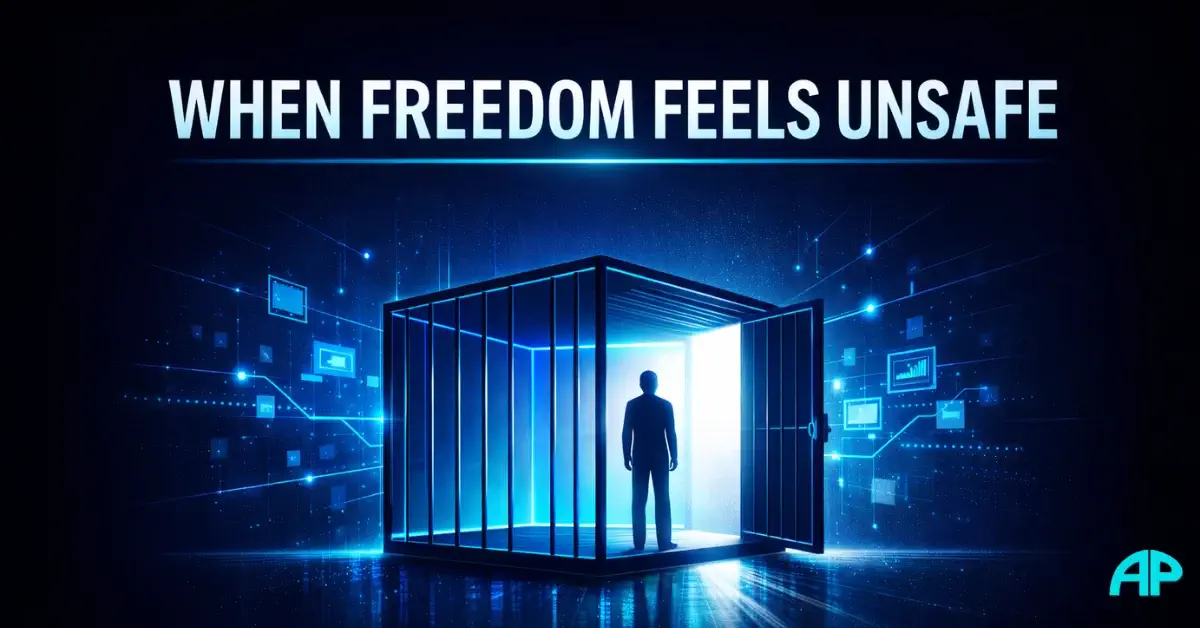
Why some people welcome lockdowns again, and why control can feel safer than choice.
I just came across a video of a woman suggesting that lockdowns were actually a good thing.
At first, that alone made me pause.
However, what happened next was the part that really got me.
I started reading the comments, and to my absolute surprise, there were a lot of people genuinely supportive of the idea of another lockdown. Not joking. Not trolling. Instead, they were actively welcoming it.
Because that made no sense on the surface, I did what I don’t usually do when something feels upside down. I asked ChatGPT a simple question.
What’s the psychology behind people wanting lockdowns again?
And the answer basically comes down to this.
When freedom feels unsafe, some people reach for rules, structure, and authority because it feels like relief.
So I’m sharing it here, because I think this mindset explains a lot more than just lockdowns.
The psychology behind wanting lockdowns again
On the surface, it seems irrational. However, psychologically, it can be surprisingly logical once you strip the emotion out of it.
So here are the main drivers behind why some people want lockdowns again.
1. Certainty feels safer than freedom
For a certain personality type, freedom is stressful.
So, lockdowns remove choice.
Then, they remove decisions.
As a result, they remove ambiguity.
And therefore, they remove responsibility.
In other words, someone else tells you:
- where you can go
- when you can go
- what’s allowed
Because of that, the structure creates artificial safety, even if it’s damaging long term.
2. External authority replaces personal responsibility
Lockdowns can outsource thinking.
For example, when rules are imposed, people don’t have to assess risk, make judgment calls, or stand alone in their choices. As a result, that feels comforting for people who:
- struggle with uncertainty
- fear being wrong
- fear social judgement
So the inner logic becomes: if I’m just following rules, I can’t be blamed.
3. Moral superiority and identity
For some, lockdowns became a moral identity.
So supporting restrictions equals being good, responsible, caring.
Meanwhile, opposing them equals being selfish or dangerous.
Because morality is now attached to the belief, logic barely matters anymore. Instead, it becomes tribal.
4. Secondary gains: This one matters, because a lot of people quietly benefited last time.
For instance:
- working from home
- reduced social pressure
- fewer expectations
- financial support
- an excuse to withdraw
So lockdowns validated avoidance. And if your normal life feels overwhelming, then lockdowns can feel like relief.
5. Fear conditioning
Over time, constant threat messaging can rewire stress responses.
So for some people, fear feels familiar, and familiarity feels safe. As a result, peace and normality can actually trigger anxiety.
Therefore, when a new threat appears, it can feel grounding. Strange, yes. However, it’s real.
6. Learned helplessness
When people are trained that:
- individuals can’t fix things
- systems are too big
- experts must decide everything
Then they stop believing in personal agency altogether.
So lockdowns fit perfectly into that mindset. In other words: nothing I do matters anyway.
7. Escaping an unfulfilling life
This is uncomfortable, but it’s worth saying.
If someone:
- hates their job
- feels stuck
- lacks purpose
- feels socially disconnected
Then a lockdown externalises the failure. So instead of facing their life, the story becomes: it’s not my life that’s broken, it’s the world.
As a result, that can feel emotionally relieving.
The key insight
Very few people want lockdowns.
Instead, what they often want is:
- relief from responsibility
- protection from uncertainty
- permission to stop trying
- a sense of meaning or moral clarity
So here’s the real punchline.
When freedom feels unsafe, control starts to feel like comfort.
And because lockdowns deliver that comfort temporarily, some people end up wanting them back.
Why this matters
If you value autonomy, responsibility, self-direction, and freedom, then this mindset can feel almost incomprehensible.
However, it’s not about intelligence. Instead, it’s about coping styles.
Some people cope by stepping up.
Others cope by handing over control.
The uncomfortable take no one wants to say out loud
I’d also argue that a large portion of the people openly welcoming lockdowns again are effectively NPCs, completely caught up in the matrix.
They wake up each day, turn on the TV, absorb the news narrative, and unconsciously outsource their thinking. Over time, that constant exposure shapes how they see risk, authority, and reality itself.
As a result, fear becomes normalised. Control feels familiar. And compliance starts to feel like virtue.
When your worldview is filtered almost entirely through mainstream media, government messaging, and expert authority, lockdowns don’t look like oppression. Instead, they look like protection.
If you want to go deeper into this pattern, read Hybrid NPCs: The Fake Awakened Still Feeding the Beast.
From that position, it becomes almost impossible to reconcile the reality.
The massive financial damage.
The psychological fallout.
The destroyed small businesses.
The isolation.
The long-term anxiety and division.
If you’re still cheering for lockdowns after seeing all of that, it’s hard to explain it purely through logic.
The more likely explanation is conditioning.
Because once someone is fully immersed in the matrix, freedom isn’t empowering anymore. It’s threatening.
And when freedom feels unsafe, people don’t ask better questions. They ask for tighter rules.