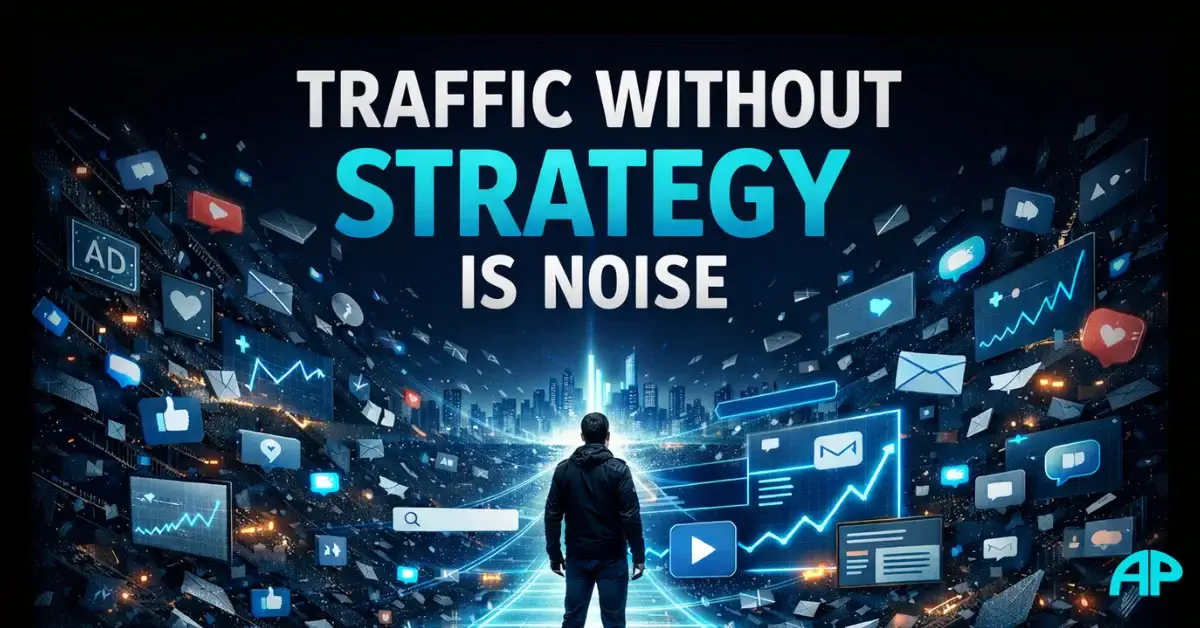
Where to get traffic, what platforms work, and what converts
Understanding traffic sources for online business is one of the smartest things you can do if you want to grow with more clarity and less wasted effort. This guide breaks down where traffic comes from, which platforms suit different goals, and how to build a stronger system around the right kind of attention.
Table of Contents
- What Are Traffic Sources
- Why Better Traffic Wins
- Main Types of Traffic Sources
- Search Engine Traffic
- Blogging as an Asset
- Social Media Traffic
- YouTube Traffic
- Email Traffic
- Paid Ads
- Referrals and Community
- Best Sources by Model
- Build a Brand
- Build a Traffic System
- Final Thoughts
- Frequently Asked Questions
Everyone wants more traffic.
More clicks. More eyeballs. More people landing on a website.
On the surface, that sounds like progress.
However, a lot of people chasing traffic are chasing the wrong kind. They post constantly, boost random content, and try to be everywhere at once. Yet despite all that activity, they still do not build much. Momentum stays weak. Trust remains shallow. Results never quite land.
That is where the frustration begins.
The goal is not just more traffic.
The goal is better traffic.
You want traffic that fits your business. You want traffic that matches your message. Most importantly, you want traffic that lands on the right offer and has a genuine chance of turning into trust, leads, sales, and long term growth.
That is exactly why understanding traffic sources for online business matters so much.
Without that understanding, it is easy to waste months on noise. You can publish content, run ads, or chase trends without building anything solid underneath it all. In contrast, a business that understands where attention comes from and how to use it well has a much better chance of creating real leverage.
The channels have changed over the years, but the core truth has not. Online business has always been about getting attention and directing it well. If you want useful perspective on that evolution, read The History of Affiliate Marketing. It is a good reminder that tools change, platforms shift, and trends come and go, yet traffic remains central to the game.
In this guide, we will break down the main traffic sources for online business, the strengths and weaknesses of each one, the main platforms to get traffic online, and how to think more strategically about building something that lasts.
Traffic Sources for Online Business That Actually Work
Traffic sources are simply the places your visitors come from before they land on your website, blog, landing page, store, video, or offer.
For example, if somebody finds you on Google and clicks through to your site, Google is the traffic source. If they watch one of your videos on YouTube and then visit your landing page, YouTube is the traffic source. Likewise, if they click a link from your email newsletter, email is the traffic source.
Common traffic sources include:
- search engines
- blogs
- social media platforms
- YouTube
- email marketing
- paid ads
- referrals from other websites
- online communities
- direct visits
At first glance, that sounds simple.
Even so, not all traffic sources perform the same way. Some bring high intent visitors. Others bring casual browsers. Some can be built slowly and keep working for years. Others spike fast and disappear just as quickly. A few help you build an asset, while others keep you dependent on a platform you do not control.
For that reason, traffic should never be treated as just a numbers game.
It is a quality game.
It is a relevance game.
And it is very much a trust game.
Why Better Traffic Beats Bigger Traffic
A thousand random visitors can look impressive in your analytics.
Still, those numbers do not mean much if none of those people care.
This is where many business owners get fooled. They confuse attention with progress. They assume reach equals results. In reality, reach is only useful when it connects the right audience with the right message and the right next step.
Better traffic usually has a few things going for it:
- clear intent
- audience relevance
- some level of trust
- alignment between the content and the offer
- a reason to take action
As a result, someone actively searching Google for a solution may be worth far more than someone half watching your reel while standing in line for coffee.
Both count as traffic.
Only one may actually move the needle.
So when you think about how to get website traffic, do not just ask how to get more people. Instead, ask how to get the right people. That single shift in thinking can save a lot of wasted time and effort.
The Main Types of Traffic Sources for Online Business
Before getting into individual platforms, it helps to zoom out and look at the main categories. Once you understand the buckets, the strategy becomes much clearer.
Organic Traffic
Organic traffic is traffic you do not directly pay for.
Usually, it comes from search engines, blog content, YouTube discovery, and organic social media reach. It often takes longer to build. However, it can become incredibly valuable because it compounds over time.
Paid Traffic
Paid traffic is traffic you buy.
That includes Google Ads, Facebook Ads, Instagram Ads, YouTube Ads, sponsored placements, and other paid campaigns. On the upside, paid traffic can be fast, scalable, and useful for testing. On the downside, it can also become expensive very quickly if the foundation is weak.
Owned Traffic
Owned traffic comes through channels you control more directly.
Email is the obvious example. Private communities, SMS lists, and membership platforms fit here too. Because people have already chosen to hear from you, owned traffic tends to be warmer.
Referral Traffic
Referral traffic comes from other websites, creators, directories, communities, podcasts, and mentions.
Often, this kind of traffic is highly valuable because it comes with borrowed trust.
Direct Traffic
Direct traffic comes from people who already know you.
They type your website into the browser, click a bookmark, or come back because you are already on their radar. Quietly, this is often a sign that your brand is starting to stick.
Search Engines Are Still One of the Best Traffic Sources for Online Business
Search remains one of the best traffic sources for a very simple reason.
Intent.
When someone goes to Google or Bing and types in a question, a problem, or a specific solution, they are actively looking. They are not passively scrolling. Instead, they are seeking something out.
That makes search traffic powerful.
It also makes search one of the most durable traffic sources for online business because good pages can keep working long after they are published. One useful article can attract visitors month after month. A strong service page can keep bringing leads. Likewise, a well structured piece of content can pull in traffic while you are off doing something else.
That is the beauty of search. It can compound.
Of course, it is not instant. Search engine traffic usually takes patience, consistency, and decent content. It also helps if your site is well structured, your pages are relevant, and your topics match what people are actually looking for. When those pieces line up, search becomes one of the smartest long term plays online.
Not surprisingly, this is also where blogging starts to matter in a serious way.
Blogging Is More Than Content. It Is Asset Building
A blog is not just a place to post words.
A good blog is a traffic asset.
Every strong article gives you another chance to rank, another page that can be shared, another entry point into your ecosystem, and another opportunity to build authority around your topic.
That is why blogging still matters.
People love to say blogging is dead. It is not. Bad blogging is dead. Generic blogging is dead. Thoughtless blogging is dead. Useful content that solves problems, answers questions, and supports a bigger brand is still incredibly valuable.
When people talk about traffic sources for online business, blogging still deserves serious attention because it helps build momentum over time instead of relying on quick spikes.
Why Blogging Still Works
A blog can help you:
- attract search traffic
- answer questions your audience is already asking
- support affiliate offers
- build trust before the sale
- grow an email list
- strengthen your authority
- feed content into social media and video
That is not a small thing.
In fact, blogging is still one of the smartest answers to how to get website traffic in a way that can keep paying off. If you want a stronger foundation here, go read Blogging for Beginners. It is a strong companion piece because it connects traffic strategy with practical content creation.
Social Media Traffic Can Work, but Every Platform Plays a Different Game
Social media can absolutely drive traffic.
At the same time, it can eat your time alive if you use it badly.
The big mistake is treating all social platforms as if they work the same way. They do not. Each one has its own rhythm, its own behaviour, and its own kind of audience.
Facebook still works well for communities, groups, discussion, and relationship building. It is useful when you want to stay visible with a warmer audience and create conversation around your ideas.
Instagram is strong for visual branding, short form content, and staying front of mind. However, getting traffic off Instagram often depends on how engaged your audience already is.
TikTok
TikTok can create reach very quickly. That is the attraction. However, reach is not the same as stable business growth. Traffic from TikTok can be useful, but it is often fast moving and less predictable.
LinkedIn is strong for consultants, agencies, coaches, service providers, and people building authority in the business space. It suits insight driven content and clearer positioning.
X and Threads
These platforms can work well for opinion based content, thought leadership, quick ideas, and sharp observations. Generally, they are best used to build attention around a point of view rather than serve as your only traffic engine.
So yes, social media matters. However, it usually works best as part of a bigger system. On its own, it can be unstable. Used properly, it can support the rest of your traffic strategy.
YouTube Is a Search Engine, a Trust Builder, and a Traffic Channel
YouTube deserves special treatment because it is not just another social media platform.
It is part search engine.
Part content library.
Part discovery engine.
Part trust machine.
That is a serious combination.
A YouTube video can bring people in through search, suggested videos, browse features, shares, or subscribers returning to your content. In addition, it gives you something text alone cannot always deliver as quickly, which is human connection. People hear your voice. They get a feel for you. They stay longer. They understand more.
That trust matters.
Why YouTube Has Long Term Value
YouTube is also one of the more flexible platforms to get traffic online because a single video can be turned into:
- blog content
- short clips
- emails
- social posts
- quote graphics
- lead generation assets
If your business benefits from explanation, education, commentary, tutorials, or personality driven content, YouTube is worth taking seriously.
Email Is Still One of the Most Valuable Traffic Channels You Can Build
Email is not the newest tool in the room.
That is exactly why people overlook it.
Yet email remains one of the most reliable traffic sources for online business because it is one of the few channels you actually have some control over. You are not relying on an algorithm to decide whether your audience sees your message. You are not starting from zero every time you publish something.
Instead, you are building a direct relationship.
That changes the game.
Why Email Traffic Matters
Email traffic is often warmer. People on your list already know your name, your message, or your offer. They have already raised their hand. That means email is not just about sending promotions. Rather, it is about staying connected, building trust, sharing useful content, and moving people towards the next step.
That is why smart business owners use other traffic sources to build their list.
Search brings them in.
Blogging warms them up.
Social media keeps you visible.
YouTube builds connection.
Email keeps the relationship alive.
That is how a real system starts to form.
Paid Ads Can Work Fast, but They Expose Weakness Fast Too
Paid traffic can be brilliant.
Paid traffic can also be brutal.
The upside is obvious. Speed. Reach. Testing. Scale. If you have a strong message, a relevant audience, and a good offer, paid traffic can help you move quickly.
However, it is not magic.
Paid campaigns can be effective traffic sources for online business, but only when the offer, targeting, and landing page are doing their job. In truth, paid traffic is an amplifier. If your landing page is weak, it exposes that. If the offer is unclear, it exposes that too. If the targeting is off, it exposes that as well.
That is why so many people lose money with ads. They treat paid traffic as the answer when really it acts more like a spotlight. It shows what is working and what is broken.
Free Traffic vs Paid Traffic
When you compare free and paid traffic sources, this is the difference:
- free traffic often costs more time
- paid traffic costs more money
- both require strategy
The strongest businesses usually build both. First, they create a foundation with content and owned assets. Then, they use paid traffic to accelerate what already has a chance of working.
Referral Traffic and Community Traffic Are More Powerful Than People Think
Not all traffic comes from giant platforms.
In fact, some of the best visitors come through trust based channels like referrals, mentions, and communities.
This might include:
- guest posts
- podcast appearances
- backlinks from relevant sites
- niche directories
- recommendations from creators
- forum mentions
- Facebook groups
- Reddit threads
- Telegram groups
- Discord communities
The power here is simple. Someone else is putting you in front of an audience that already trusts them. Naturally, some of that trust can transfer.
The Right Way to Use Community Traffic
There is a right way and a wrong way to use these channels.
The wrong way is spam.
The right way is value.
Show up with useful ideas. Answer questions properly. Be interesting. Be helpful. Contribute like a real person. Over time, that kind of presence can bring in highly relevant traffic that converts far better than random attention.
The Best Traffic Sources for Online Business Depend on What You Are Building
There is no single answer to the question, what are the best traffic sources?
The answer depends on the business model.
For Bloggers
Search, blogging, email, and in some niches Pinterest can work very well.
For Affiliate Marketers
Blogging, search traffic, YouTube, email, and useful content across selected social channels often make the most sense.
For Service Businesses
Google search, local SEO, referrals, Google Business visibility, and email can be strong. Depending on the audience, Facebook can also help.
For Coaches and Consultants
LinkedIn, YouTube, webinars, email, and content that builds authority are often a smart mix.
For Ecommerce Brands
Google Shopping, Meta ads, email, influencer referrals, product focused content, and brand driven social media can all play a role.
So do not blindly copy someone else’s strategy. Different businesses need different traffic systems. What works for a creator may not suit a tradie. Likewise, what works for a local business may not suit an ecommerce store.
Build a Brand, Not Just a Traffic Habit
This is where the conversation gets more interesting.
Traffic matters.
However, traffic without a brand is often just borrowed attention.
If people click, glance, and disappear, you do not have much. On the other hand, if people remember you, trust you, and come back, now you are building something.
That is why the smartest traffic strategy is not just about getting seen. It is about making the attention mean something.
A brand does that.
A brand gives people a reason to remember you.
A reason to trust you.
A reason to return.
A reason to choose you over somebody else saying the same thing in a more forgettable way.
This matters even more now because platforms are unstable. Algorithms shift. Reach drops. Costs rise. Rules change. If your whole business depends on one platform staying friendly forever, that is shaky ground.
That is exactly why traffic should feed assets you control. Your website. Your email list. Your content. Your reputation. Your audience relationship.
If you want to explore where this is heading, especially with emerging tools reshaping the space, read AI and the Future of Building an Online Brand. It fits naturally here because the real opportunity is not just using AI to make more content. It is using modern tools to build something more resilient and more memorable.
Build a Traffic System Instead of Chasing Traffic in Pieces
This is where everything starts to connect.
Most people chase traffic in fragments.
A post here.
A reel there.
A boosted ad next week.
A blog article when they feel like it.
That is not a system. That is scattered effort.
A better approach is to build a traffic system where each channel supports the others.
What a Simple Traffic System Can Look Like
For example:
- write a strong blog post around a topic your audience cares about
- optimise it for search
- turn the topic into a YouTube video
- cut short clips from the video for social media
- send people to an email opt in
- follow up with useful emails
- guide them toward your offer, service, product, or next step
Now your traffic sources are not competing with each other. Instead, they are working together.
That is the shift.
The goal is not to do everything.
The goal is to build something connected.
That is what creates leverage.
Final Thoughts
There are more ways than ever to get attention online.
That is the good news.
The bad news is that more options often create more distraction. As a result, it becomes easy to chase every new platform, every new trend, and every little spike in attention without building anything that lasts.
That is why this matters.
The best traffic sources for online business are the ones that match your business model, build trust, and support long term growth. They are not always the flashiest ones. More often, they are the ones that bring the right people and feed into assets you actually control.
So do not just ask where traffic is.
Ask what kind of traffic fits your business.
Ask what platform suits your message.
Ask what traffic source helps you build long term leverage.
Because getting traffic is only the beginning.
What you build from that traffic is what really counts.
Frequently Asked Questions
What are the best traffic sources for online business?
The best traffic sources depend on what you are building, but search engines, blogging, YouTube, email marketing, community based traffic, and selected social media platforms are among the strongest options.
How do I get website traffic without paying for ads?
If you want to know how to get website traffic without ads, focus on SEO, blogging, YouTube, email list building, guest posts, referral traffic, and community participation. These methods take more time, but they can create stronger long term results.
What is the difference between free and paid traffic sources?
Free and paid traffic sources differ mainly in how they are built. Free traffic usually takes time, consistency, and content. Paid traffic can generate quicker results, but it requires budget and a stronger setup behind it.
Which platforms are best to get traffic online?
The best platforms to get traffic online depend on your business model. Google is powerful for intent based traffic, YouTube is strong for discovery and trust, email is excellent for owned traffic, and social media can help build awareness and reach.
Should I focus on one traffic source or many?
Start with one main source and one support channel. Build traction there first. Once you have a working foundation, expand. Trying to master every platform at once usually leads to shallow results.