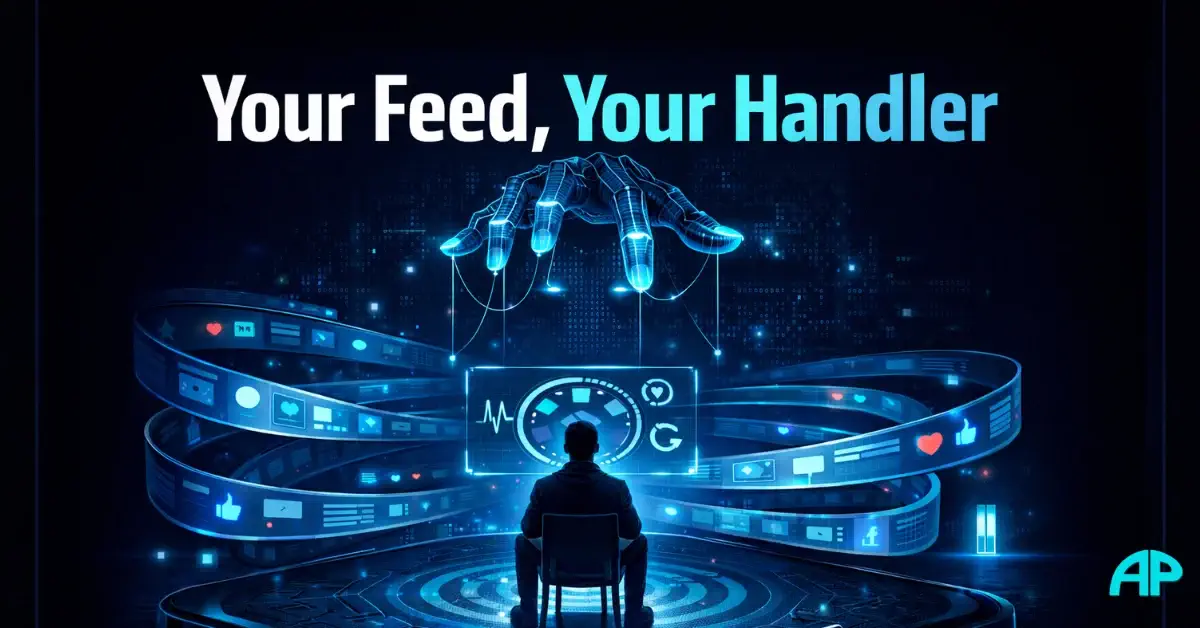
The feed is not neutral. It trains your attention, shapes your mood, and steers your beliefs.
Let’s say the quiet part out loud.
Algorithm is not your friend.
It is not your buddy.
It is not your helper.
It is not your personal curator, lovingly assembling a feed that matches your vibe.
Instead, it is your handler.
And the weird part is, it does not even hate you. In fact, it is not personal at all. Rather, it is just business.
If you have ever felt your mood shift after ten minutes online, then you already know this is real. You just might not have had a clean phrase for it yet. So, Algorithm is not your friend is not a slogan. It is a warning label.
Your feed is not a mirror. It is a steering wheel.
Most people think the feed reflects what they like.
That is half true.
However, what it really does is test you, almost like a lab rat with a touchscreen.
First, it shows you something.
Then, you react.
Next, it remembers.
After that, it shows you more of whatever got a stronger reaction.
Not better content.
Stronger reaction.
That is how algorithm manipulation works. In other words, it is not about what is good for you. Instead, it is about what keeps you engaged. More specifically, it is about the fastest path to another tap, another swipe, another comment, another minute.
As a result, minute by minute, your feed becomes less like a library and more like a hallway with moving walls.
Here is the part most people miss. Algorithm is not your friend because it does not reflect your best self. Rather, it reflects your most clickable self.
The algorithm does not reward truth. It rewards tension.
Here is the problem.
Truth is often calm.
Truth is sometimes boring.
Truth takes a minute to land.
Meanwhile, outrage lands instantly.
Likewise, fear lands instantly.
And yes, moral superiority lands instantly too.
So the system learns something simple.
Calm people close the app.
Reactive people keep scrolling.
That is not a moral judgement. Instead, that is attention economy control. Basically, the feed is tuned like an instrument. It plays the notes that make you stay.
Therefore, you can open your phone to check one thing and suddenly you are ten posts deep into a manufactured fight between strangers. At that point, Algorithm is not your friend because its business model depends on keeping you emotionally spiked.
Social media conditioning looks like this
You open your phone for a second.
Then you close it 47 minutes later.
Afterwards, you feel slightly wired.
Slightly annoyed.
Slightly scattered.
And then you do it again tomorrow.
That is social media conditioning.
It trains you to crave stimulation, not meaning.
It trains you to respond, not reflect.
It trains you to confuse consumption with progress.
And the most brutal part is this.
You can become extremely informed and still be completely ineffective.
You can know every headline and still be stuck.
Because information without action becomes a sedative. In other words, it gives you the feeling of movement without the results of movement. That is a feature of attention economy control. Consequently, it keeps you watching, reacting, reposting, arguing, and repeating.
Busy, but not building.
So, Algorithm is not your friend if it turns you into a spectator of your own life.
The algorithm builds a version of you that is easy to predict
Your real self is complicated.
You can hold two ideas at once.
You can change your mind.
You can be nuanced.
However, the algorithm hates nuance.
Why? Because nuance does not click as well.
So, it tries to flatten you into patterns.
For instance, it watches:
- what you pause on
- what you share
- what you comment on
- what you hate-watch
- what you argue about at midnight
Then, it serves you more of that.
Over time, it nudges you into a personality that is easier to predict and easier to sell to. That is the handler part. Still, it is not always sinister in a movie villain way. Rather, it is simply the logic of algorithm manipulation meeting ad revenue.
The platform is not asking, what is true?
Instead, it is asking, what keeps you here?
So if you are still unsure, repeat it: Algorithm is not your friend. Friends do not train you into a narrower version of yourself.
“But I choose what I watch”
Sure.
In the same way you choose what snacks you buy while walking through a supermarket that was engineered to make you hungry.
Your choices exist.
However, the environment is built to influence them.
That is why the strongest move is not trying to beat the algorithm at its own game.
Instead, the strongest move is taking your attention back.
Because when you control your attention, you control your life. And attention economy control is exactly what you are up against. Not a person. A system.
The algorithm is a slot machine in your pocket
It is not just the content.
It is also the randomness.
Sometimes you get something hilarious.
Sometimes you get something shocking.
Sometimes you get something validating.
Sometimes you get something that makes you furious.
That variability is the hook.
In fact, it is the same psychology as a poker machine.
So, the feed is not designed to satisfy you. Instead, it is designed to keep you pulling the lever. That is why social media conditioning can feel like a spell. The moment you stop scrolling, your brain goes, hang on, what did I miss?
Nothing. You missed nothing.
Rather, you just interrupted the machine.
And if you stay in it long enough, it starts to shape how you think.
Shorter attention.
More impatience.
More jumping between tabs.
Less depth.
Less silence.
Less ability to sit with a problem long enough to solve it.
That is why Algorithm is not your friend is not dramatic. It is accurate.
So what do we do? Break the loop without becoming a monk
You do not need to move into a cave.
Instead, you just need rules.
Boring rules.
Effective rules.
Rules that starve the machine and feed your life.
Here are a few that work.
1. Decide what you use the platform for
First, pick one. Two max.
Examples:
- messaging
- learning a skill
- promoting your work
- keeping up with a few people you genuinely care about
If it does not fit the purpose, then it is noise.
This is how you keep social media conditioning from turning into your default operating system.
2. Create no feed zones
Messaging is fine.
However, endless feed is the trap.
Most apps allow you to go straight to inbox, notifications, or your own profile.
So, make the feed the last place you go, not the first.
If your thumb automatically opens the feed, that is not a personality flaw. Instead, that is algorithm manipulation working exactly as designed.
3. Stop training it to train you
The algorithm learns from your behaviour.
Therefore, starve it.
Do not hate-watch.
Do not rage-comment.
Do not click bait that annoys you.
Because every reaction is a vote.
Even your anger is useful to it.
This is the sneaky part of algorithm manipulation. It does not care if you love something or hate it. It only cares that you cannot look away.
4. Replace scrolling with building
This is the big one.
If you spend 45 minutes consuming, then spend 45 minutes creating.
Write.
Walk.
Lift.
Build a page.
Send an email.
Cook real food.
Make something.
Learn how to start an online business
Creation breaks the spell because it puts you back in the driver’s seat. Also, it weakens social media conditioning because it gives your brain a different reward cycle.
This is how you break the scrolling loop without quitting the internet entirely.
5. Do a weekly reset
Pick one day a week.
No feeds.
Use that time to think.
You will be shocked how quickly your mind calms down when the constant input stops.
At first, the silence feels uncomfortable.
That is the withdrawal.
Then, it starts to feel like power.
Because the absence of attention economy control feels like breathing clean air again.
The punchline
Algorithm is not your friend.
It is a machine built to maximise your attention and monetise your behaviour. In short, that is attention economy control in its purest form.
That does not mean you should fear it.
Instead, it means you should treat it like fire.
Useful.
Powerful.
Dangerous if you get lazy.
Because if you do not choose what enters your mind, then someone else will.
And the handler never sleeps.
Frequently Asked Questions
Is algorithm manipulation intentional?
Yes, in the sense that platforms optimise for time on app, clicks, shares, and ad performance. Therefore, the outcomes are predictable even if no one sits there plotting your mood.
Can I use social media without being controlled by it?
Yes. Use it with a purpose. Limit the feed. Focus on creation. Starve the outrage loop. As a result, you reduce social media conditioning fast.
Why does my feed feel more extreme over time?
Because extremes trigger stronger reactions. Consequently, stronger reactions create longer sessions. Then, longer sessions create more ad revenue. That is attention economy control at work.
What is the fastest way to break the scrolling loop?
First, remove the trigger. Then, turn notifications off. Next, reduce feed access. Finally, replace the habit with a build habit. Even 20 minutes of creation per day changes everything. That is how you break the scrolling loop in real life, not theory.
Does this apply to news and politics too?
Absolutely. In fact, the more emotional the topic, the more the algorithm can steer behaviour through fear, outrage, and tribal identity. That is algorithm manipulation turned up to full volume.